Professional Development
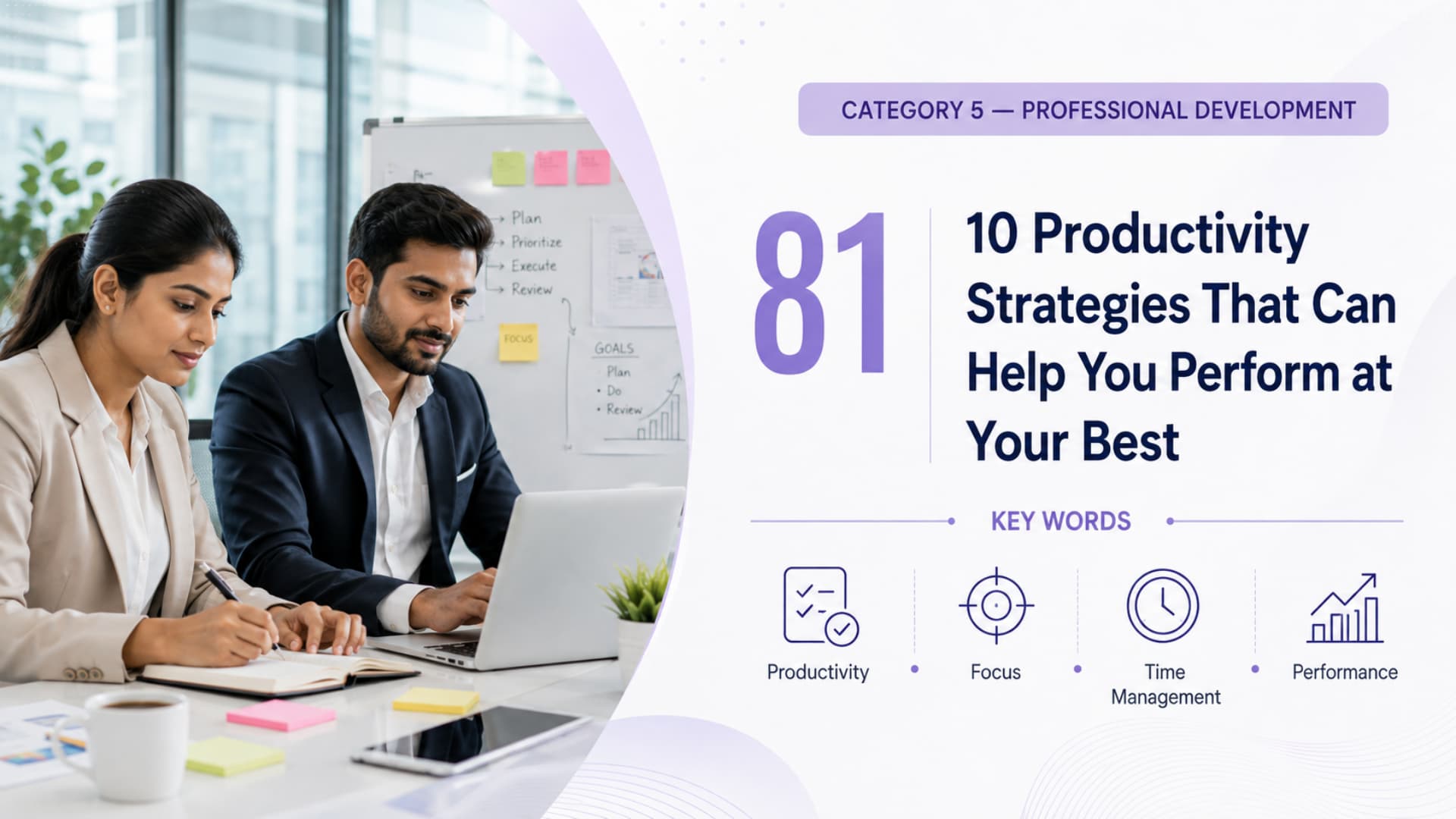
10 Productivity Strategies That Can Help You Perform at Your Best
Productivity • Professional Performance • Work Efficiency • Focus • Career Development Productivity • Professional Performance • Work Efficiency • Focus • Career Development
Productivity is not about doing more every minute.
It is about using your time, energy and attention on the work that matters most.
Many professionals stay busy all day but still feel they have not completed their most important priorities.
The solution is not always longer working hours.
It is often a better system.
Here are 10 practical productivity strategies that can help you perform at your best.
________________________________________
1. Identify Your Highest-Value Work
Not every task contributes equally.
Ask:
• Which work creates the biggest impact?
• What moves the project forward?
• What requires my best thinking?
• What can be delayed or delegated?
Why It Helps
You spend more time on important work instead of getting trapped in low-value activity.
Professional Rule
Do what matters most before what feels easiest.
________________________________________
2. Work in Focused Blocks
Choose a specific task and give it uninterrupted time.
For example:
45–60 minutes focused work → Short break
During the focus block:
• Silence notifications
• Close unnecessary tabs
• Avoid switching tasks
Why It Helps
Deep focus improves both speed and quality.
Productivity Principle
One task. One block. Full attention.
________________________________________
3. Plan Your Day Before It Begins
Do not start the day by reacting to emails and messages.
Set:
• Top priorities
• Important deadlines
• Focus periods
• Meetings
• Follow-up actions
Why It Helps
A plan creates direction before distractions appear.
Daily Habit
Plan first. React second.
________________________________________
4. Break Large Tasks Into Smaller Actions
Large projects can create delay because they feel difficult to start.
Instead of:
“Complete the presentation.”
write:
Create outline → Draft slides → Add visuals → Review → Finalise
Why It Helps
Smaller actions make progress visible and reduce procrastination.
Work Rule
Make the next step obvious.
________________________________________
5. Reduce Multitasking
Switching constantly between tasks may feel productive, but it often reduces concentration.
Try to avoid:
• Writing while checking messages
• Joining meetings while answering emails
• Switching between unrelated projects every few minutes
Why It Helps
Single-tasking reduces mental switching and improves accuracy.
Professional Mindset
Do fewer things at the same time. Do each one better.
________________________________________
6. Use Your Peak Energy Wisely
Your energy may not be the same throughout the day.
Notice when you feel:
• Most focused
• Most creative
• Most mentally sharp
Use that period for your hardest or most important work.
Why It Matters
Productivity depends on energy management as much as time management.
Productivity Tip
Match demanding work with your strongest energy.
________________________________________
7. Control Meetings
Meetings can consume large amounts of productive time.
Before scheduling one, ask:
• Is a meeting necessary?
• What is the objective?
• Who really needs to attend?
• What decision should be made?
Why It Helps
Clear meetings are shorter and more useful.
Meeting Rule
No clear purpose, no meeting.
________________________________________
8. Create Systems for Repetitive Work
If you repeat a task regularly, create a system.
Use:
• Templates
• Checklists
• Standard processes
• Saved responses
• Automation tools
Why It Helps
Systems reduce repeated thinking and save time.
Professional Principle
Do not solve the same routine problem from zero every time.
________________________________________
9. Take Strategic Breaks
Continuous work does not always produce continuous performance.
Short breaks can help restore:
• Attention
• Mental energy
• Perspective
• Accuracy
Why It Helps
A short reset may help you return with better focus.
Work Rhythm
Focus → Pause → Reset → Continue
________________________________________
10. Review What Actually Worked
At the end of the day or week, ask:
• What created the most value?
• What wasted time?
• Which distractions repeated?
• What should I stop doing?
• What should I improve?
Why It Helps
Productivity improves when you learn from your own work patterns.
Improvement Loop
Work → Review → Adjust → Improve
________________________________________
The PERFORM Formula
P — Prioritise
Focus on high-value work.
E — Eliminate Distractions
Protect attention.
R — Reduce Task Switching
Work with deeper focus.
F — Focus on Clear Actions
Break projects into manageable steps.
O — Organise Systems
Simplify repetitive work.
R — Recharge
Use breaks and manage energy.
M — Measure and Improve
Review what actually works.
________________________________________
Key Takeaway
Productivity is not about filling your calendar.
It is about creating better results with greater clarity and control.
Build your system around:
Priorities • Focus • Planning • Single-Tasking • Energy • Systems • Breaks • Review
The goal is not to be busy all day. The goal is to make your best work happen consistently.
Brain Gurukul Perspective
At Brain Gurukul, we believe professional performance depends on interconnected abilities such as focus, self-management, decision-making, learning agility and mental clarity.
Productivity improves when professionals manage their attention and energy with the same care they give to their time.
Focus better. Work smarter. Perform at your best.
Read. Learn. Apply. Grow.
________________________________________
Blog Number: 81
Blog Name: 10 Productivity Strategies That Can Help You Perform at Your Best
Word Count: ~760 words
Productivity • Professional Performance • Work Efficiency • Focus • Career Development Productivity • Professional Performance • Work Efficiency • Focus • Career Development