Education Entrepreneurship & Franchise
10 Questions to Ask Before Choosing an Education Franchise
Education Franchise • Franchise Selection • Education Business • Franchise Opportunity • Entrepreneurship
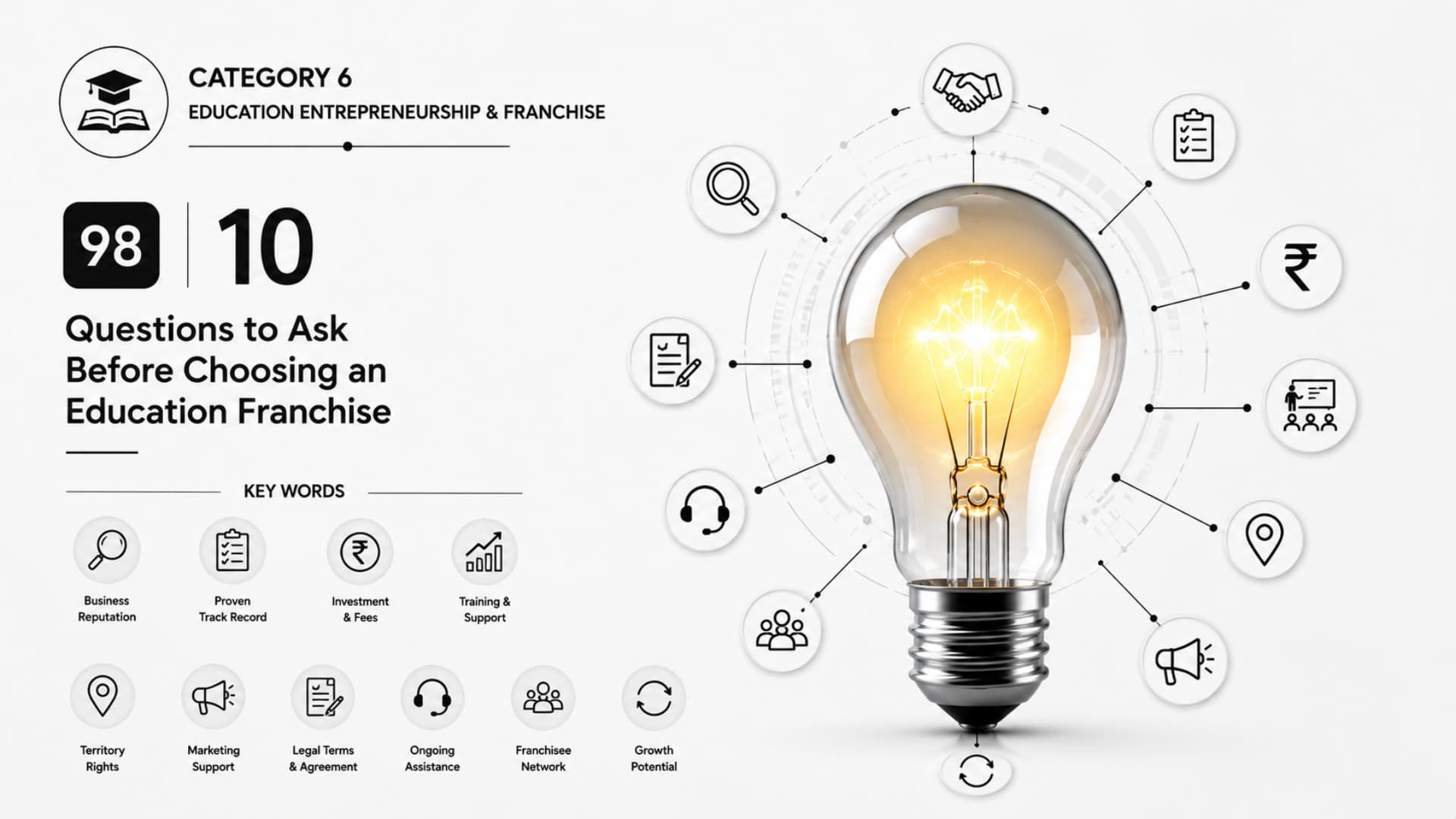
Choosing an education franchise is a major business decision.
A strong brand name or attractive presentation is not enough.
Before investing, you need to understand the business model, programme quality, support system, costs, market potential and your own role as a franchise partner.
Here are 10 important questions to ask before choosing an education franchise.
________________________________________
1. What Problem Does This Education Brand Solve?
Start with the core value proposition.
Ask:
• What learner need does the brand address?
• Is the category relevant?
• Is the programme solving a real problem?
• Is the positioning clear?
Why It Matters
A franchise becomes easier to market when the value proposition is easy to understand.
Decision Rule
Do not buy the brand before understanding the problem it solves.
________________________________________
2. Who Is the Target Customer?
You should know exactly who the business is designed for.
For example:
• Young children
• School students
• Teenagers
• Parents
• Teachers
• Professionals
• Schools
Why It Helps
A clearly defined audience makes local marketing, counselling and programme planning easier.
Franchise Question
“Is there enough demand for this audience in my local market?”
________________________________________
3. How Strong Is the Programme Portfolio?
Do not evaluate only one popular programme.
Look at the complete offering.
Ask:
• How many programmes are available?
• Are they relevant to different age groups?
• Can learners continue into other programmes?
• Is there potential for repeat enrolment?
Why It Matters
A broader portfolio can create more revenue opportunities and longer customer relationships.
Business Principle
One programme may create an enrolment. A strong portfolio can create an ecosystem.
________________________________________
4. What Training Will I Receive?
Understand exactly what training is included.
This may cover:
• Programme delivery
• Counselling
• Operations
• Sales
• Technology
• Staff development
• Academy management
Why It Helps
Training reduces the learning curve.
Important Question
“Will I be trained only before launch, or will support continue afterward?”
________________________________________
5. What Support Does the Franchisor Provide?
Ask for clarity on ongoing support.
Look for areas such as:
• Academy setup
• Marketing
• Sales
• Recruitment
• Technology
• Operations
• Programme expansion
Why It Matters
Support can make execution easier, especially for first-time entrepreneurs.
Franchise Rule
Do not assume support. Ask what is actually included.
________________________________________
6. What Is the Complete Investment?
Do not focus only on the franchise fee.
Ask about:
• Franchise fee
• Infrastructure
• Furniture
• Technology
• Equipment
• Marketing
• Staff
• Working capital
• Royalty
• Renewal charges
• Taxes
Why It Helps
You need to understand the total financial commitment.
Investment Rule
Calculate the complete business cost, not just the entry cost.
________________________________________
7. How Does the Revenue Model Work?
Understand how the business earns money.
Ask about:
• Programme pricing
• Average enrolment value
• Repeat enrolments
• School partnerships
• Multiple programme sales
• Royalty structure
• Operating costs
Why It Matters
Revenue potential should be evaluated realistically.
Business Principle
Do not judge a franchise only by revenue projections. Understand the economics behind them.
________________________________________
8. Is the Model Suitable for My Local Market?
A strong national brand may still need local adaptation.
Evaluate:
• Parent demographics
• School density
• Competition
• Income levels
• Education awareness
• Local demand
• Suitable territory
Why It Helps
The same model may perform differently in different cities.
Market Rule
A good franchise must still fit the local market.
________________________________________
9. What Will Be Expected From Me?
Understand your own role.
Will you need to:
• Manage the academy daily?
• Build a team?
• Counsel parents?
• Conduct marketing?
• Develop school relationships?
• Track operations?
Why It Matters
Some franchise models require active owner involvement.
Self-Check
Ask:
“Does this business match my time, skills and working style?”
________________________________________
10. What Evidence Shows the Model Can Work?
Ask for meaningful proof.
This may include:
• Existing centres
• Partner experiences
• Operational history
• Parent feedback
• Programme outcomes
• Support systems
Why It Helps
Evidence creates a more informed decision.
Important Reminder
Past performance does not guarantee future success.
Local execution still matters.
________________________________________
The CHECKLIST Formula
C — Category
Understand the opportunity.
H — Help and Support
Know what the franchisor provides.
E — Economics
Understand the complete investment.
C — Customer
Know who you will serve.
K — Knowledge and Training
Understand how you will be prepared.
L — Local Market
Check territory potential.
I — Involvement
Know your role.
S — Systems
Evaluate operations and technology.
T — Track Record
Look for evidence.
________________________________________
Key Takeaway
Choosing an education franchise should be based on more than excitement.
Evaluate:
Category • Audience • Programme Portfolio • Training • Support • Investment • Revenue Model • Local Market • Owner Role • Track Record
The right franchise is not simply the one that looks attractive—it is the one that fits your market, capability and long-term vision.
Brain Gurukul Perspective
At Brain Gurukul, we believe prospective franchise partners should understand the business model completely before making a decision.
A strong partnership begins when expectations are clear on both sides—around investment, support, systems, execution and growth.
Ask better questions. Understand the model. Choose with clarity.
Read. Learn. Apply. Grow.
________________________________________
Blog Number: 98
Blog Name: 10 Questions to Ask Before Choosing an Education Franchise
Word Count: ~780 words
Education Franchise • Franchise Selection • Education Business • Franchise Opportunity • Entrepreneurship