
Student Success & Learning Skills
10 Smart Exam Preparation Strategies for Better Confidence and Performance
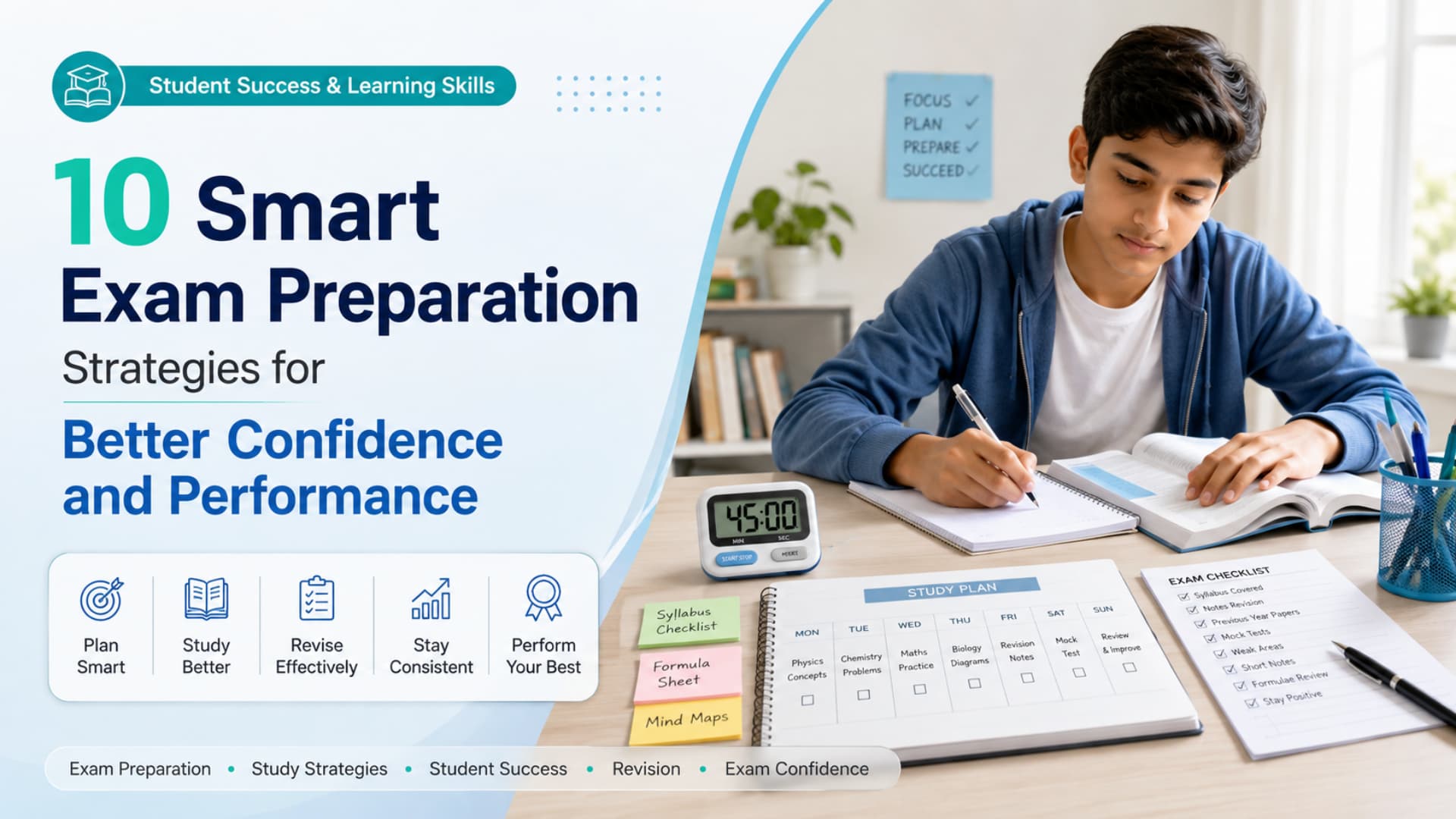
Exams often become stressful not because students cannot learn—but because preparation begins late, revision becomes unstructured, and anxiety rises as the date gets closer.
The solution is not simply:
“Study harder.”
A better approach is to prepare with a clear system that improves understanding, recall, practice and confidence.
Here are 10 smart exam preparation strategies that can help students perform better with less last-minute pressure.
________________________________________
1. Start With an Exam Plan
Before opening the books, understand:
• Exam dates
• Subjects
• Chapters
• Difficult topics
• Revision time available
Create a simple schedule.
Why It Helps
Planning reduces uncertainty and prevents important topics from being forgotten.
Exam Rule:
Plan first. Study second.
________________________________________
2. Prioritise Difficult Topics Early
Students often begin with their favourite subjects because they feel easier.
But difficult topics need more time.
Try This
Divide chapters into:
Strong • Average • Weak
Spend more time on the weak and average areas while still revising strong topics.
Why It Matters
Early attention gives difficult concepts enough time to improve.
________________________________________
3. Study in Focused Blocks
Long study sessions can become tiring and distracted.
Try:
30–40 minutes study → Short break → Next session
During each block:
• Keep your phone away
• Work on one topic
• Set one outcome
Study Tip
Do not measure preparation only by hours.
Measure:
“What did I actually complete?”
________________________________________
4. Use Active Recall
After studying, close the material.
Then ask:
• What were the main ideas?
• Can I explain the concept?
• What formula do I remember?
• What did I forget?
Why It Helps
Active recall tests whether the information can actually be retrieved.
Use:
Learn → Close → Recall → Check
This is more useful than endless rereading.
________________________________________
5. Revise With Spacing
Do not revise a topic once and forget it.
Try:
Day 1: Learn
Day 2: Recall
Day 4: Review
Day 7: Test
Why It Matters
Spaced revision gives the brain repeated opportunities to strengthen memory.
Revision works better when distributed over time.
________________________________________
6. Practise Previous Papers
Reading prepares knowledge.
Practice prepares performance.
Use:
• Previous exam papers
• Sample questions
• Mock tests
• Chapter-wise questions
Why It Helps
You learn:
• Question patterns
• Time pressure
• Common mistakes
• Application of concepts
Practice also makes the actual exam feel more familiar.
________________________________________
7. Create a Mistake List
Every mistake is useful information.
Maintain a short list of:
• Formulas you forget
• Concepts you confuse
• Repeated calculation errors
• Questions you misunderstand
Why It Matters
Instead of revising everything equally, you can focus on your actual weaknesses.
Exam Rule
Mistake → Understand → Correct → Retry
________________________________________
8. Make Short Revision Notes
Do not carry full textbooks into final revision.
Create concise:
• Formula sheets
• Mind maps
• Flashcards
• Definitions
• Key dates
• Important diagrams
Why It Helps
Short notes make quick revision easier and reduce overload before exams.
Summarise more. Search less.
________________________________________
9. Practise Under Timed Conditions
Knowing an answer is different from producing it within exam time.
Set a timer and practise sections under realistic conditions.
Why It Matters
Timed practice improves:
• Speed
• Question selection
• Time allocation
• Exam confidence
Also practise leaving a few minutes at the end for checking answers.
________________________________________
10. Protect Sleep Before the Exam
All-night studying can reduce concentration and make recall harder the next day.
Instead:
• Finish major learning earlier
• Keep final revision light
• Prepare materials in advance
• Sleep adequately
Why It Matters
Your brain needs recovery to perform well.
Remember
A rested brain usually performs better than an exhausted one.
________________________________________
The EXAM Formula
E — Establish a Plan
Know what and when to study.
X — eXamine Weak Areas
Prioritise what needs improvement.
A — Actively Recall and Apply
Test yourself and practise questions.
M — Manage Time and Mind
Use timed practice, breaks and good sleep.
________________________________________
Key Takeaway
Successful exam preparation is not built in one stressful night.
It grows through:
Planning • Focus • Recall • Revision • Practice • Mistake Correction • Rest
Instead of asking:
“How much syllabus is left?”
also ask:
“How much of what I studied can I actually recall and apply?”
That is the real test of preparation.
Brain Gurukul Perspective
At Brain Gurukul, we believe exam success should come from stronger learning strategies rather than last-minute pressure.
When students prepare systematically, they enter exams with better clarity, recall and confidence.
Prepare smarter. Practise better. Perform with confidence.
Read. Learn. Apply. Grow.
________________________________________
Blog Number: 43
Blog Name: 10 Smart Exam Preparation Strategies for Better Confidence and Performance
Word Count: ~785 words