
Student Success & Learning Skills
10 Smart Study Habits That Can Help Students Learn More in Less Time
Smart Study Habits • Study Skills • Student Success • Learning Faster • Time Management
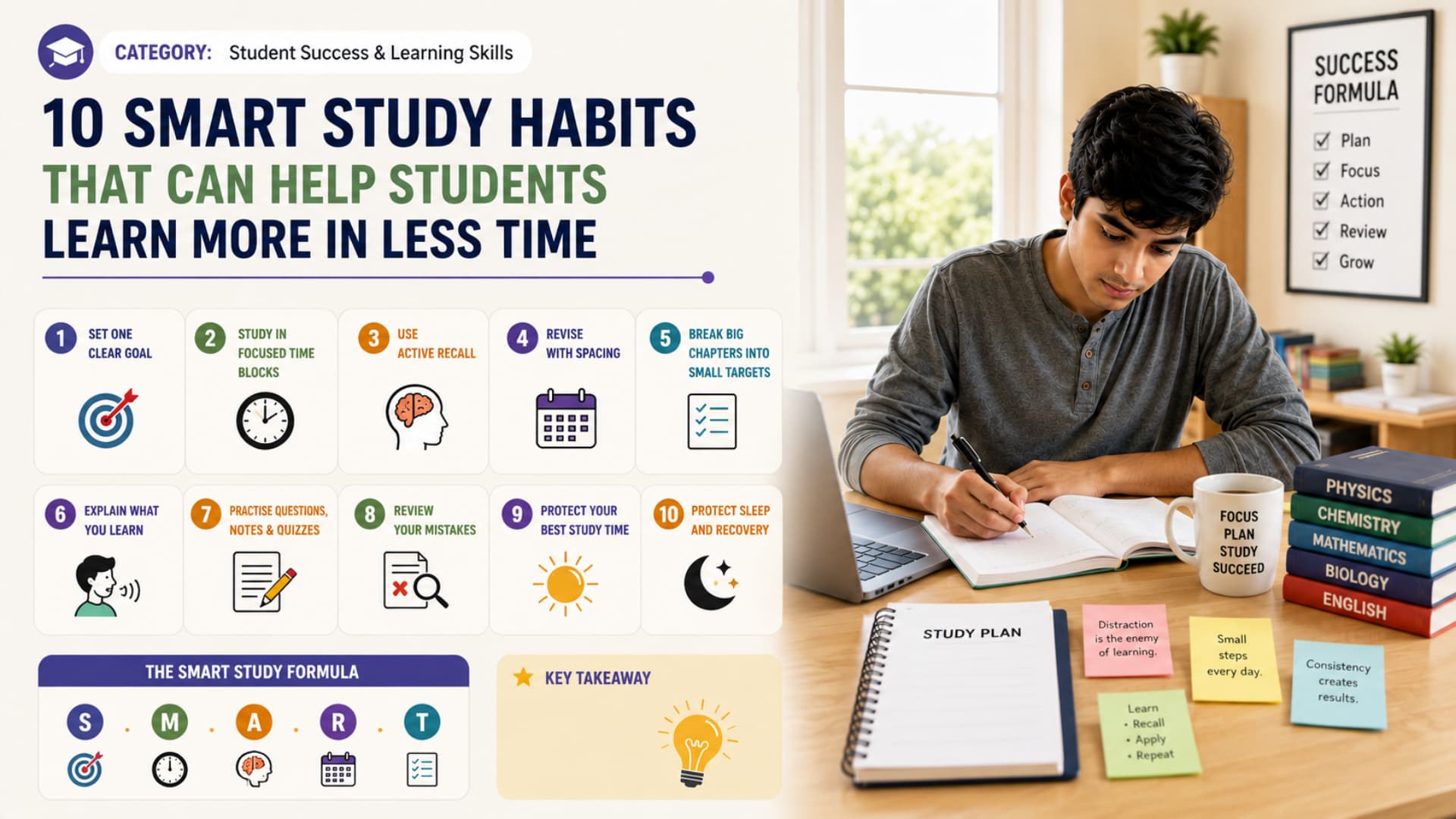
Studying longer does not always mean learning better.________________________________________
A student can sit with books for three hours and still remember very little if the session is distracted, passive or poorly planned.
The real goal should be:
Learn more effectively—not simply study for more hours.
Smart study habits help students focus better, remember more, revise efficiently and reduce last-minute stress.
Here are 10 practical habits that can help students learn more in less time.
________________________________________
1. Set One Clear Goal Before You Start
Do not begin with:
“I will study science.”
Make the goal specific:
“I will understand photosynthesis and answer five questions.”
Why It Works
A clear goal gives your attention direction.
One session = One measurable outcome.
________________________________________
2. Study in Focused Time Blocks
Long, unbroken sessions often lead to tiredness and distraction.
Try:
25–40 minutes focused study → Short break → Next session
During the focus block:
• Keep your phone away
• Avoid unnecessary tabs
• Work on one task
Study Tip
Quality of attention matters more than simply counting hours.
________________________________________
3. Use Active Recall
Reading the same page repeatedly may make it look familiar.
But can you explain it without looking?
After studying a section:
Close the book and recall the main ideas.
Ask:
• What did I learn?
• What were the key points?
• What did I forget?
Use:
Read → Close → Recall → Check
This turns passive reading into active learning.
________________________________________
4. Revise With Spacing
Do not wait until the night before the exam.
Try:
Day 1: Learn
Day 2: Quick recall
Day 4: Review
Day 7: Self-test
Why It Works
Repeated revision across time helps strengthen memory and reduces the need for emergency cramming.
Revise little and often.
________________________________________
5. Break Big Chapters Into Small Targets
A 30-page chapter can feel overwhelming.
Break it into:
• Topic 1
• Topic 2
• Practice questions
• Summary
• Revision
Why It Matters
Small targets make progress visible.
Instead of thinking:
“I have so much left.”
you begin thinking:
“I have completed three parts already.”
________________________________________
6. Explain What You Learn
One powerful way to check understanding is to teach the topic.
Pretend you are explaining it to a younger student.
If you cannot explain something simply, you probably need to understand it better.
Try This
After learning, ask:
“Can I explain this in my own words?”
Teaching exposes gaps quickly.
________________________________________
7. Practise Questions, Not Only Notes
Reading notes is useful.
But exams require you to retrieve and apply information.
Use:
• Practice questions
• Mock tests
• Previous papers
• Flashcards
• Self-quizzes
Why It Matters
Practice helps you discover what you actually know—and what still needs work.
Testing yourself is part of studying.
________________________________________
8. Review Your Mistakes
Do not simply check the correct answer and move on.
Ask:
• Why was my answer wrong?
• Did I misunderstand the concept?
• Did I rush?
• Did I forget a step?
• What should I do differently?
Study Rule
Mistake → Understand → Correct → Retry
One corrected mistake can prevent many future mistakes.
________________________________________
9. Protect Your Best Study Time
Some students focus better in the morning.
Others perform better in the afternoon or evening.
Observe when your mind feels most alert.
Use that period for:
Difficult Subjects • Problem-Solving • New Concepts
Use lower-energy periods for:
Revision • Organising Notes • Simple Tasks
Why It Matters
Study when your brain is ready for the type of work you need to do.
________________________________________
10. Protect Sleep and Recovery
Sacrificing sleep to study all night may reduce attention and recall the next day.
A better study system includes:
Focused Study + Breaks + Revision + Adequate Sleep
Remember
Rest is not wasted study time.
It supports the brain’s ability to learn and perform.
________________________________________
The SMART Study Formula
S — Set Clear Goals
Know what you need to complete.
M — Manage Your Time
Use focused study blocks.
A — Actively Recall
Retrieve without looking.
R — Review Regularly
Use spaced revision.
T — Test Yourself
Practise questions and correct mistakes.
________________________________________
Key Takeaway
Smart studying is not about finding shortcuts.
It is about using your time intelligently.
Focus on:
Clear Goals • Active Recall • Spaced Revision • Practice • Mistake Correction • Good Rest
Instead of asking:
“How many hours did I study?”
ask:
“How much did I actually understand and remember?”
That is a much better measure of learning.
Brain Gurukul Perspective
At Brain Gurukul, we believe academic success should come from stronger learning skills—not simply longer study hours.
When students learn how to focus, recall, practise and revise intelligently, studying becomes more efficient and less stressful.
Study smarter. Learn stronger. Perform better.
Read. Learn. Apply. Grow.
________________________________________
Blog Number: 39
Blog Name: 10 Smart Study Habits That Can Help Students Learn More in Less Time
Word Count: ~780 words
Smart Study Habits • Study Skills • Student Success • Learning Faster • Time Management