
Parenting & Child Development
5 Important Differences Between Your Child’s Ability, Interest and Performance
Child Ability • Interest • Academic Performance • Parenting • Child Development
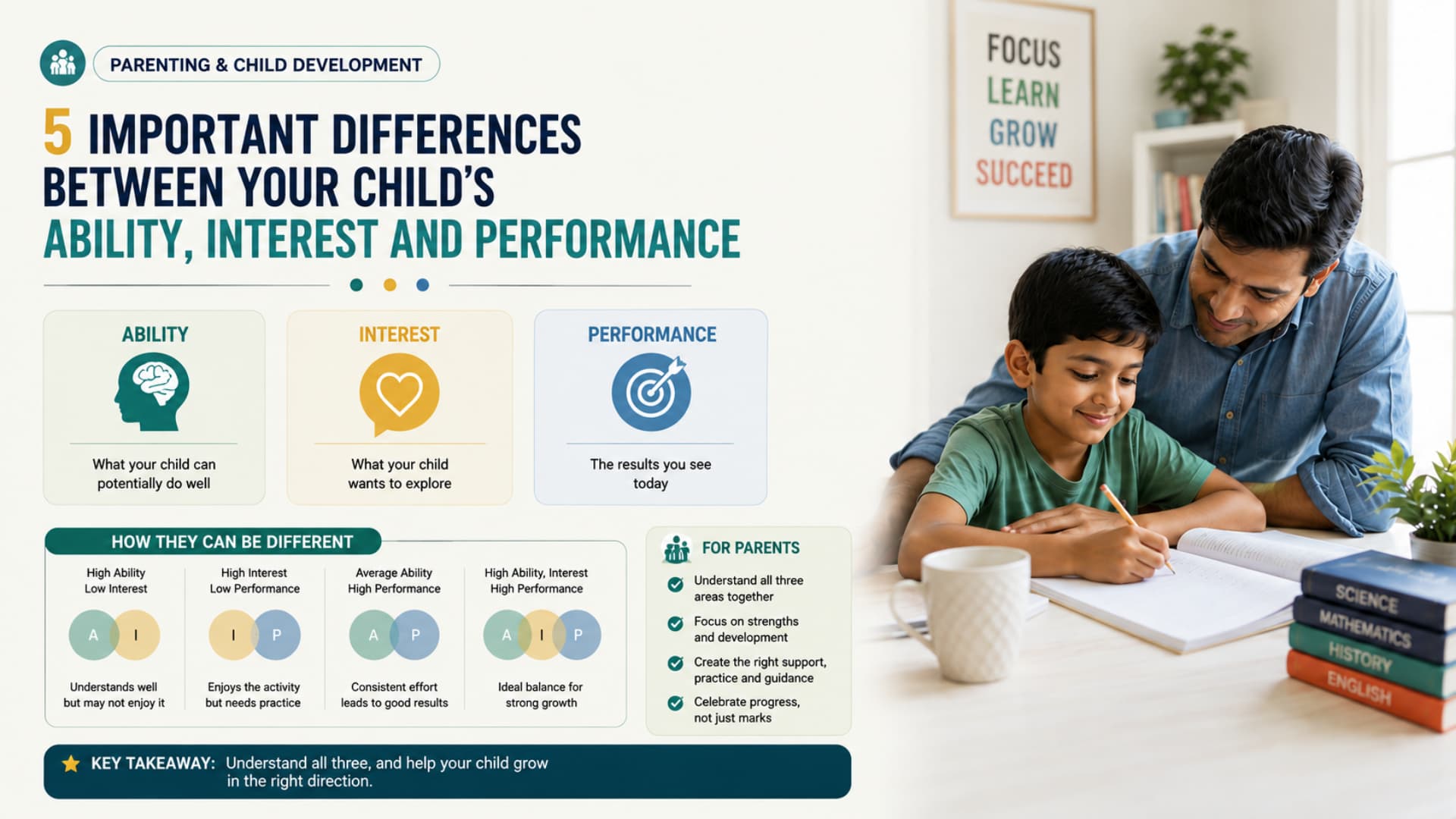
A child may be good at something but not interested in it.
Another child may love a subject but not yet perform well in it.
And sometimes strong performance happens mainly because of practice, support or routine—not because that area is the child’s strongest natural ability.
This is why parents should understand the difference between:
Ability • Interest • Performance
These three are connected—but they are not the same thing.
Here are 5 important differences every parent should understand.
________________________________________
1. Ability Is What the Child Can Potentially Do Well
Ability refers to a child’s capacity to understand, perform or develop a skill.
A child may show ability through:
• Quick understanding
• Strong memory
• Logical reasoning
• Communication
• Creativity
• Observation
• Coordination
• Problem-solving
Why It Matters
Ability may appear even before formal achievement.
For example, a child may naturally understand number patterns but still have average maths marks because of careless mistakes or poor study habits.
Parent Tip
Do not judge ability only through marks.
Look at how the child thinks and performs across different situations.
________________________________________
2. Interest Is What the Child Wants to Explore
Interest is about attraction, curiosity and enjoyment.
A child may repeatedly choose:
• Drawing
• Science experiments
• Sports
• Stories
• Technology
• Music
• Building activities
Why It Matters
Interest creates motivation.
Children usually spend more time and energy on activities they genuinely enjoy.
But interest alone does not automatically create mastery.
Example
A child may love cricket but still need years of practice to develop strong technical skill.
Interest opens the door. Practice builds competence.
________________________________________
3. Performance Is the Result You See Today
Performance is what appears in:
• Marks
• Tests
• Competitions
• Projects
• Presentations
• Practical tasks
But performance can be influenced by many factors:
• Preparation
• Practice
• Confidence
• Sleep
• Stress
• Attention
• Teaching quality
• Environment
Why It Matters
One result does not define the whole child.
A low score may reflect poor preparation rather than low ability.
Likewise, a high score may come from strong discipline even when natural interest is moderate.
Parent Rule
Performance is important—but it is only one part of the picture.
________________________________________
4. Ability, Interest and Performance Can Be Unequal
Parents often expect all three to move together.
But they may not.
A child can have:
High Ability + Low Interest
They understand quickly but do not enjoy the subject.
High Interest + Low Performance
They love the activity but still need practice.
Average Ability + High Performance
Strong discipline and consistent practice produce excellent results.
High Ability + High Interest + High Performance
This may indicate an area worth developing deeply.
Why It Matters
Understanding these combinations helps parents avoid quick conclusions.
Instead of saying:
“You scored badly, so you are not good at this.”
ask:
“Is the challenge ability, interest, preparation or performance habits?”
________________________________________
5. The Best Growth Happens When Parents Understand All Three
Parents often focus mainly on performance because marks are easy to measure.
But better guidance requires a wider view.
Ask:
Ability
What does my child seem naturally capable of doing well?
Interest
What does my child enjoy and voluntarily explore?
Performance
Where is my child currently producing good results?
Then look for patterns.
Why It Matters
When these three areas are understood together, parents can make better decisions about:
• Learning support
• Skill development
• Activities
• Career exploration
• Practice priorities
The goal is not to label the child.
It is to understand where development can happen most effectively.
________________________________________
The AIP Formula
A — Ability
What can the child potentially do well?
I — Interest
What does the child genuinely enjoy exploring?
P — Performance
What results are visible right now?
Then ask:
What is helping—or limiting—the connection between them?
This one question can make parenting decisions much clearer.
________________________________________
Key Takeaway
Ability, interest and performance are related—but different.
A child may:
Have ability without interest.
Have interest without mastery.
Perform well through practice.
Develop ability over time.
That is why parents should avoid judging children through only one score, one subject or one moment.
Look at the complete picture.
Understand the ability. Observe the interest. Improve the performance.
Brain Gurukul Perspective
At Brain Gurukul, we believe meaningful development begins with understanding the learner beyond academic marks.
Discovering strengths, interests and current performance helps parents guide children more intelligently and create better development opportunities.
Know the child beyond the report card.
Read. Learn. Apply. Grow.
________________________________________
Blog Number: 35
Blog Name: 5 Important Differences Between Your Child’s Ability, Interest and Performance
Word Count: ~760 words
Child Ability • Interest • Academic Performance • Parenting • Child Development