Teachers, Schools & Education
6 Classroom Strategies to Develop Creativity and Problem-Solving Skills
Creativity • Problem-Solving • Classroom Strategies • Innovation • Student Thinking
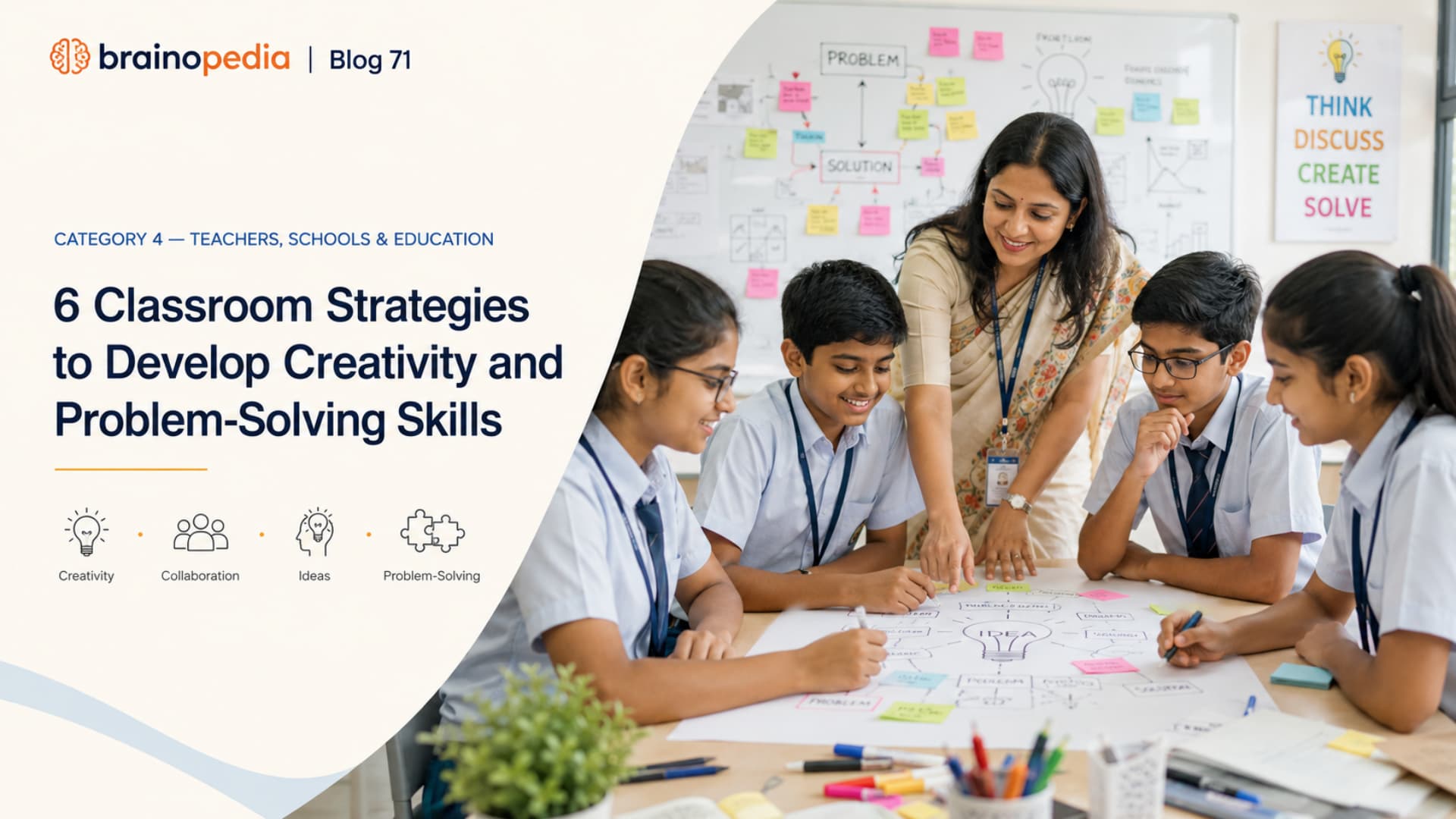
Creativity and problem-solving are not separate from academic learning.
They are the skills that help students generate ideas, explore possibilities, overcome challenges and apply knowledge in new situations.
A classroom that encourages only one correct answer may limit these abilities.
Students need regular opportunities to question, experiment, create and improve.
Here are 6 practical classroom strategies that can develop creativity and problem-solving skills.
________________________________________
1. Ask Open-Ended Questions
Instead of asking only:
“What is the correct answer?”
also ask:
• What are some other possibilities?
• How else could this be solved?
• What would you change?
• What might happen if...?
Why It Helps
Open-ended questions encourage students to explore multiple ideas.
They learn that some problems can have more than one valid approach.
Teaching Rule
Do not always ask for one answer. Ask for better thinking.
________________________________________
2. Give Real Problems to Solve
Use situations that feel meaningful.
For example:
• How can we reduce classroom waste?
• How would you design a better study space?
• What could make school transport more efficient?
• How could we save water at school?
Why It Helps
Real problems require students to combine knowledge with imagination.
Problem-Solving Loop
Identify → Think → Create → Test
________________________________________
3. Encourage Brainstorming Before Judging Ideas
Students often reject ideas too early because they are afraid of being wrong.
During brainstorming, first focus on generating possibilities.
Ask students to:
• List many ideas
• Build on others' suggestions
• Try unusual approaches
• Avoid immediate criticism
Why It Helps
Creativity grows when students feel free to explore.
Evaluation can happen later.
Classroom Principle
Create first. Judge later.
________________________________________
4. Use Design-and-Build Challenges
Give students simple challenges that require them to create something.
They might:
• Build a model
• Design a poster
• Create a prototype
• Develop a solution
• Plan an experiment
Why It Helps
Hands-on challenges move learning from theory to application.
Students must make decisions, test ideas and improve what they create.
Learning Cycle
Imagine → Build → Test → Improve
________________________________________
5. Treat Mistakes as Useful Information
Creative problem-solving requires experimentation.
Not every idea will work.
Instead of treating failure as the end, ask:
• What went wrong?
• What did we learn?
• What could we change?
• What should we try next?
Why It Matters
Students become more willing to take thoughtful risks.
Classroom Mindset
A failed attempt can become useful feedback.
________________________________________
6. Let Students Explain Different Solutions
After solving a problem, ask students to share their approach.
Two students may reach the same answer in different ways.
Discuss:
• Which method was simplest?
• Which was most creative?
• Which could work in another situation?
• What can we learn from each approach?
Why It Helps
Students begin to appreciate different ways of thinking.
Teacher Rule
Celebrate the thinking process, not only the final answer.
________________________________________
The CREATE Formula
C — Challenge Assumptions
Ask different questions.
R — Recognise the Problem
Understand what needs to be solved.
E — Explore Possibilities
Generate multiple ideas.
A — Act on an Idea
Build or test a solution.
T — Try Again
Learn from mistakes.
E — Explain the Solution
Share and improve the thinking.
________________________________________
Key Takeaway
Creativity and problem-solving grow through practice.
Students need opportunities to:
Question • Imagine • Brainstorm • Build • Test • Improve • Explain
These abilities become stronger when classrooms value exploration as much as correct answers.
Do not only teach students to solve known problems. Prepare them to face new ones.
Brain Gurukul Perspective
At Brain Gurukul, creativity, innovation and critical problem-solving are important parts of holistic intellectual development.
Students become stronger learners when they are encouraged to explore possibilities, test ideas, learn from mistakes and apply knowledge in unfamiliar situations.
Teachers can build these abilities by creating classrooms where curiosity and experimentation are actively supported.
Imagine boldly. Solve intelligently. Improve continuously.
Read. Learn. Apply. Grow.
________________________________________
Blog Number: 71
Blog Name: 6 Classroom Strategies to Develop Creativity and Problem-Solving Skills
Word Count: ~740 words
Creativity • Problem-Solving • Classroom Strategies • Innovation • Student Thinking