Brain Science & Brain Optimization
6 Emerging Brain Optimization Strategies That Could Transform the Way We Learn
Brain Optimization • Adaptive Learning • AI in Education • Neurofeedback • Future Learning
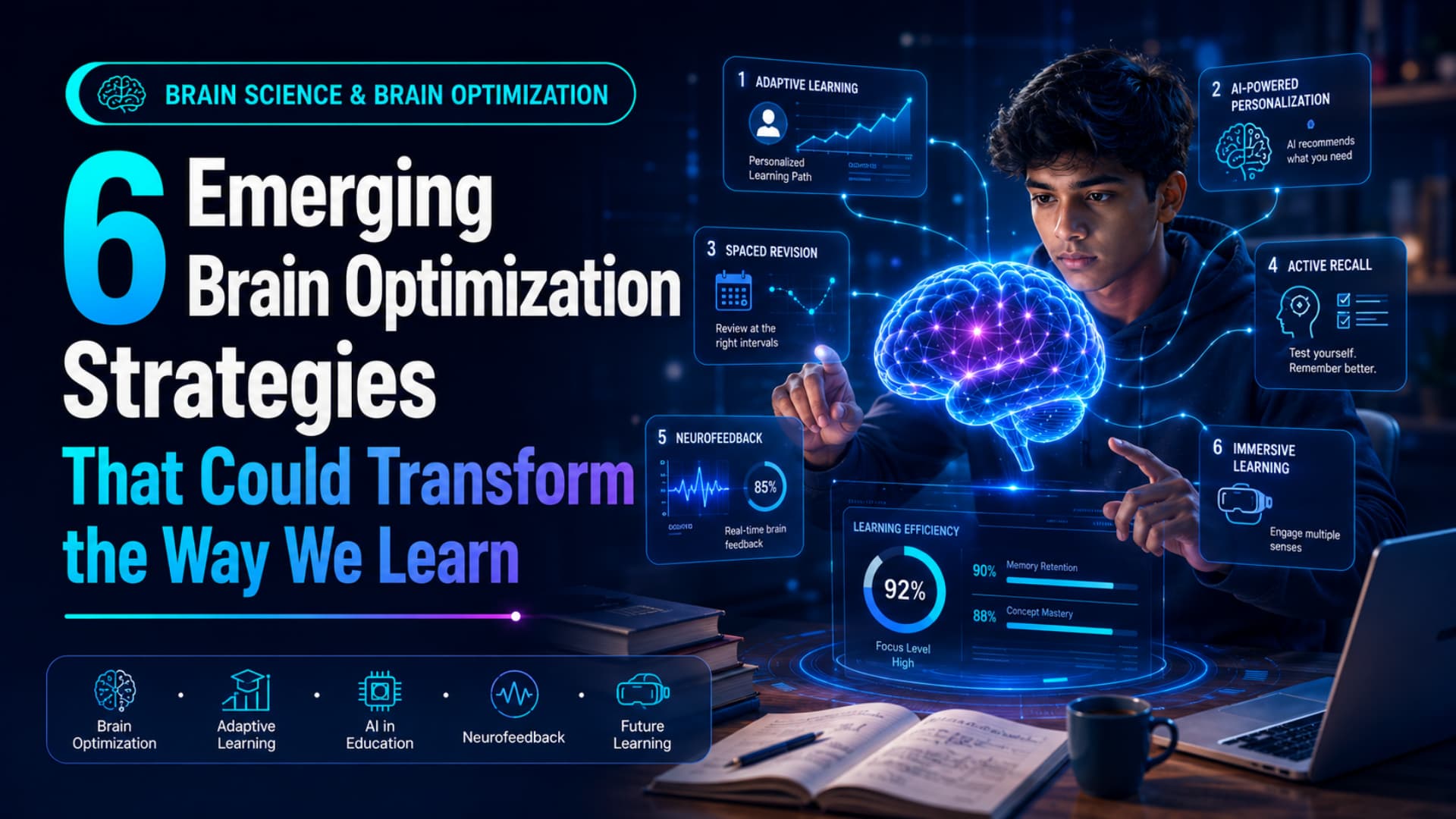
What if learning could become more personalised, responsive and brain-aware?
For decades, education has largely followed a common pattern: same content, same pace, same method.
But advances in neuroscience, artificial intelligence and learning science are opening new possibilities.
The future of Brain Optimization may not be about studying more. It may be about understanding when, how and why each learner learns best.
Here are 6 emerging strategies that could transform the way we learn.
________________________________________
1. AI-Powered Adaptive Learning
Imagine a learning system that notices:
• What you understand
• Where you struggle
• How quickly you progress
• Which questions you repeatedly miss
• When you need revision
…and then adjusts the learning path automatically.
This is the idea behind adaptive learning.
Recent reviews show that AI-enabled adaptive platforms can personalise content, sequencing and support based on learner performance, although privacy, implementation quality and teacher involvement remain important considerations.
Why It Matters
Instead of forcing every learner through the same route:
Learning can begin adapting to the learner.
________________________________________
2. Smarter Spaced Revision
Spaced learning itself is not new.
What is changing is how intelligently it can be delivered.
Digital systems can track when a learner is likely to forget something and schedule revision at more useful intervals.
Instead of:
Learn → Forget → Relearn
future systems can increasingly support:
Learn → Recall → Review at the Right Time → Strengthen
Why It Matters
This can make revision more efficient and reduce unnecessary repetition.
The goal becomes:
Review when your brain needs it—not simply when the timetable says so.
________________________________________
3. Retrieval-Based Learning Instead of Passive Reading
Future-ready learning is moving away from endless rereading.
A stronger approach asks the learner to actively retrieve knowledge.
For example:
Read → Close → Recall → Answer → Check
Digital learning tools can increasingly build short quizzes, flashcards and recall challenges directly into the learning journey.
Why It Matters
Learning becomes active rather than passive.
Students are not just asking:
“Have I read this?”
They begin asking:
“Can I remember and use this?”
That is a much better measure of learning.
________________________________________
4. Neurofeedback and Brain-Based Feedback
Neurofeedback uses measurements of brain activity to provide feedback that may help individuals practise regulating certain patterns of activity.
This area is receiving significant attention—but it should be approached carefully.
Recent research shows mixed results depending on the population, outcome and protocol. Some studies report benefits in particular executive-function measures, while broader reviews caution against treating neurofeedback as a universally effective solution.
Why It Matters
The exciting idea is real-time feedback.
But the science is still developing.
Brain Optimization should remain evidence-led, not technology-led.
________________________________________
5. Multisensory and Immersive Learning
Learning does not happen only through reading.
People can learn through combinations of:
• Visuals
• Sound
• Movement
• Interaction
• Demonstration
• Simulation
Emerging technologies such as interactive environments and immersive simulations can make difficult ideas more experiential.
Imagine learning:
Human anatomy through a 3D model.
History through an immersive reconstruction.
Science through interactive experimentation.
Why It Matters
The future classroom may increasingly shift from:
“Tell me about it”
to:
“Let me experience and understand it.”
________________________________________
6. Precision Learning Through Performance Data
Traditional education often measures learning mainly through final marks.
Future learning systems can potentially examine much more:
• Response time
• Error patterns
• Revision frequency
• Areas of strength
• Difficult concepts
• Learning progression
This creates the possibility of precision learning—using data to decide what the learner should practise next.
Why It Matters
Instead of asking:
“Did the student score 70%?”
we can ask:
“Which 30% needs attention—and why?”
That creates a far more useful learning conversation.
________________________________________
The FUTURE Learning Formula
F — Feedback
Know where improvement is needed.
U — Unique Learning Path
Personalise the journey.
T — Timed Revision
Review strategically.
U — Use Active Recall
Retrieve instead of only rereading.
R — Real-World Experience
Make learning interactive.
E — Evidence
Use technology only when supported by sound learning principles.
________________________________________
Key Takeaway
The future of learning will probably not be defined by technology alone.
The real transformation will happen when technology, neuroscience and good teaching work together.
Personalised. Active. Measurable. Adaptive. Human-centred.
That is where Brain Optimization can become truly powerful.
Brain Gurukul Perspective
At Brain Gurukul, we see Brain Optimization as a journey of understanding the learner, strengthening abilities and designing better learning experiences.
Technology can support that journey—but the learner must always remain at the centre.
The future of learning is not more information. It is smarter learning.
Read. Learn. Apply. Grow.
(WC = 763)
Brain Optimization • Adaptive Learning • AI in Education • Neurofeedback • Future Learning