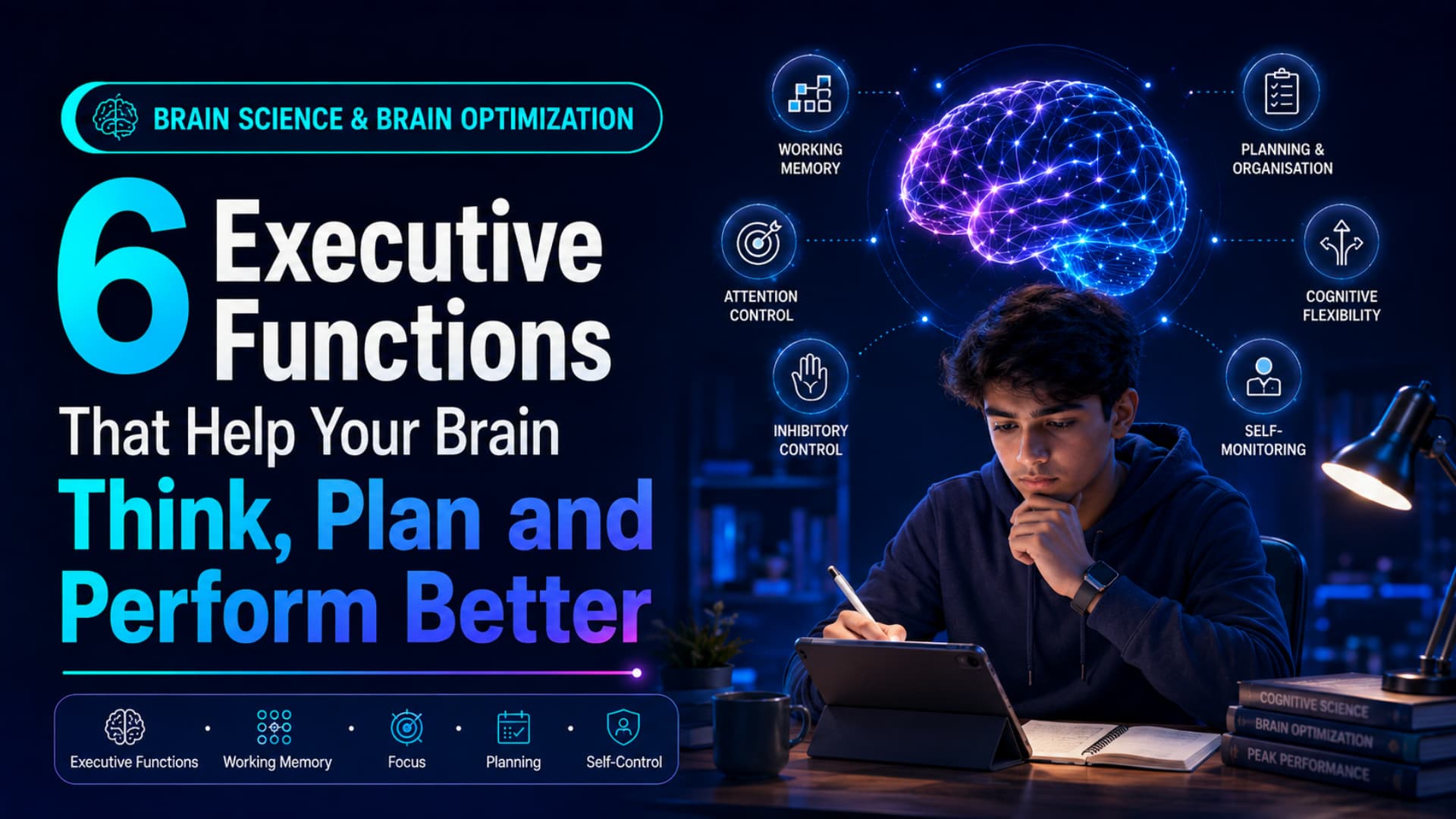
Brain Science & Brain Optimization
6 Executive Functions That Help Your Brain Think, Plan and Perform Better
Executive Functions • Working Memory • Focus • Planning • Self-Control
Have you ever wondered why some people can stay organised, follow instructions, manage time, solve problems and stay calm under pressure better than others?
A big part of the answer lies in executive functions.
Executive functions are the brain’s high-level management skills. They help us control attention, remember important information, plan actions, manage behaviour and adapt when situations change.
In simple words, executive functions help the brain act like a smart control centre.
Here are 6 important executive functions that help you think, plan and perform better.
________________________________________
1. Working Memory Helps You Hold and Use Information
Working memory is your brain’s ability to keep information in mind for a short time while using it.
For example:
• Remembering a phone number long enough to dial it
• Following 3-step instructions
• Solving a maths problem mentally
• Keeping key points in mind while reading
Without working memory, learning becomes harder because the brain struggles to hold and process information at the same time.
How to Strengthen It
• Break large information into smaller parts
• Repeat key points aloud
• Use visual aids and notes
• Practise mental maths and recall games
Working memory helps you keep the mind active while learning.
________________________________________
2. Attention Control Helps You Stay Focused
Attention control helps you direct your focus toward what matters and reduce distraction.
This is important while:
• Studying
• Listening in class
• Completing assignments
• Following conversations
• Solving tasks carefully
A person may be intelligent, but without attention control, performance can still suffer.
How to Improve It
• Work on one task at a time
• Set a clear target before starting
• Keep distractions away
• Study in short focused time blocks
• Take meaningful breaks
Attention is the entry gate of learning.
If attention is weak, understanding and memory also get affected.
________________________________________
3. Inhibitory Control Helps You Manage Impulses
Inhibitory control is the ability to pause, resist and choose wisely instead of reacting immediately.
It helps with:
• Not interrupting others
• Avoiding careless mistakes
• Resisting distractions
• Staying calm in emotional moments
• Following rules and routines
For students, this may mean not checking the phone every few minutes while studying.
For adults, it may mean thinking before speaking or acting.
Build This Skill by:
• Pausing before reacting
• Counting to five before responding
• Using checklists
• Practising self-discipline in small ways
• Creating structured routines
Self-control protects performance.
________________________________________
4. Planning and Organisation Help You Get Things Done
Planning and organisation help you decide:
• What needs to be done
• In what order
• How much time it may take
• What materials are needed
• How to move from start to finish
This is essential for academic work, projects, events, professional tasks and everyday life.
A learner may know what to do—but without planning, the work often becomes delayed, incomplete or stressful.
Improve Planning Skills by:
• Writing daily goals
• Using to-do lists
• Breaking big tasks into smaller steps
• Estimating time realistically
• Preparing materials in advance
Planning turns intention into action.
________________________________________
5. Cognitive Flexibility Helps You Adapt
Cognitive flexibility is the ability to adjust your thinking when situations change.
It helps when:
• One method is not working
• A question needs a different approach
• Plans suddenly change
• You need to shift between ideas
• You must understand another point of view
This skill is very important in modern learning because real life rarely follows one fixed pattern.
You Can Strengthen It by:
• Trying different methods to solve problems
• Looking at situations from different angles
• Accepting feedback
• Learning new skills
• Becoming comfortable with change
Flexible thinking helps the brain respond intelligently, not rigidly.
________________________________________
6. Self-Monitoring Helps You Check Your Own Performance
Self-monitoring means noticing how well you are doing while performing a task.
It helps you ask:
• Am I understanding this?
• Am I making mistakes?
• Am I on track?
• Do I need to slow down?
• Should I change my strategy?
This function is important because it helps learners become more independent.
Instead of waiting for someone else to correct everything, the person begins noticing and improving performance on their own.
How to Develop It
• Review your work before submitting
• Use self-check questions
• Compare outcomes with goals
• Reflect on mistakes
• Ask, “What can I improve next time?”
Self-monitoring makes progress visible.
________________________________________
The EXECUTE Formula
To remember these 6 executive functions, think of this simple learning formula:
E — Engage Working Memory
Hold and use information.
X — eXert Attention Control
Stay focused on the task.
E — Exercise Inhibitory Control
Resist distractions and impulses.
C — Create a Plan
Organise steps and resources.
U — Use Flexible Thinking
Adapt when needed.
T — Track Your Performance
Monitor and improve your work.
________________________________________
Key Takeaway
Executive functions are not just academic skills.
They are life skills.
They help children learn better, students perform better, professionals work better and individuals become more independent, organised and capable.
If you want stronger performance, don't focus only on information.
Also strengthen the mental processes that help you use information effectively.
Brain Gurukul Perspective
At Brain Gurukul, we believe true learning is not only about what a learner knows, but also about how effectively the learner can focus, plan, remember, adapt and apply knowledge.
That is why executive functions are an important part of Brain Optimization.
When the brain’s control centre becomes stronger, learning becomes smarter.
Read. Learn. Apply. Grow.
(WC = 886)