Parenting & Child Development
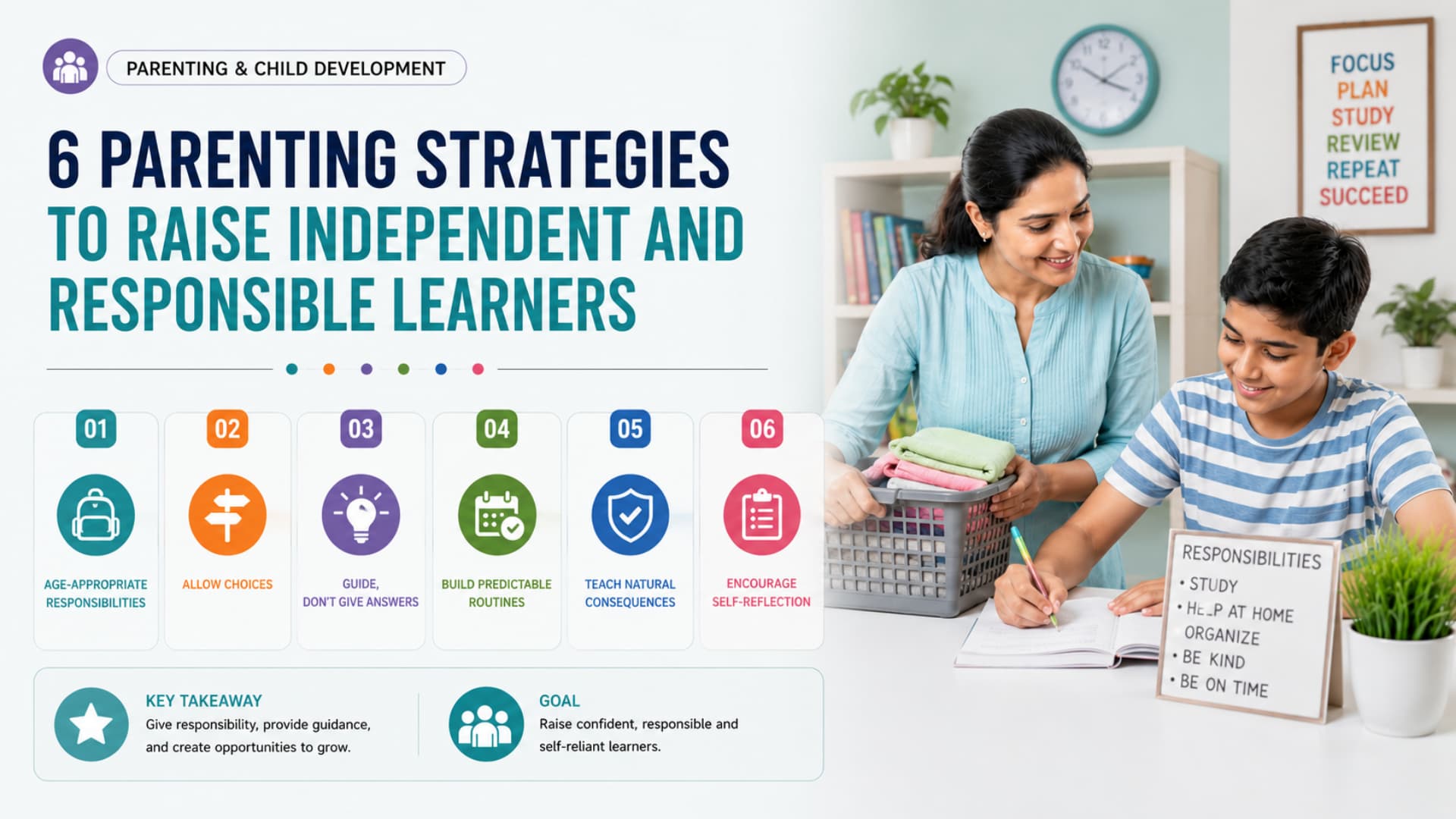
6 Parenting Strategies to Raise Independent and Responsible Learners
Independent Learners • Responsible Children • Parenting Strategies • Self-Discipline • Child Development
Every parent wants a child who can study, make decisions, solve problems and manage responsibilities without constant reminders.
But independence does not develop automatically.
It grows when children are gradually given choices, responsibilities, routines and opportunities to think for themselves.
The goal is not to remove parental guidance.
It is to shift slowly from:
“I will do it for you.”
to:
“I will help you learn how to do it yourself.”
Here are 6 parenting strategies that can help raise more independent and responsible learners.
________________________________________
1. Give Age-Appropriate Responsibilities
Children become responsible by practising responsibility.
Start with manageable tasks such as:
• Packing their school bag
• Organising books
• Keeping their study area tidy
• Preparing materials for class
• Completing simple household duties
Why It Matters
When parents do everything for children, children get fewer opportunities to develop ownership.
Start small and increase responsibility gradually.
Parent Tip:
Do not ask, “Can my child do everything alone?”
Ask:
“What can my child start doing independently today?”
________________________________________
2. Let Children Make Small Decisions
Decision-making is a skill that develops through practice.
Allow children to make reasonable choices such as:
• Which homework task to complete first
• How to organise their desk
• Which book to read
• When to take a study break
• Which extracurricular activity interests them
Why It Matters
Children who make small decisions learn to think about options and consequences.
Parents should still guide major decisions.
But children also need space to develop judgement.
Learning Rule
Give choices within healthy boundaries.
________________________________________
3. Stop Solving Every Problem Immediately
When children struggle, parents naturally want to step in.
But solving every difficulty can create dependence.
Before giving the answer, ask:
• What do you think the problem is?
• What have you already tried?
• What else could work?
• Which option would you choose?
Why It Matters
This helps children practise:
Thinking • Problem-Solving • Persistence • Decision-Making
Support should remain available.
But the child should participate in finding the solution.
Guide more. Rescue less.
________________________________________
4. Build Predictable Routines
Independence becomes easier when children know what needs to happen.
A simple routine might look like:
School → Rest → Study → Play → Dinner → Prepare for Tomorrow
Why It Matters
Routines reduce the number of reminders parents need to give.
Instead of hearing:
“Do your homework!”
every day, the child gradually understands that homework belongs to a regular part of the routine.
Parent Tip
Use a simple checklist for younger children.
Over time, allow them to manage the checklist themselves.
Routine turns responsibility into habit.
________________________________________
5. Let Natural Consequences Teach
Children sometimes learn best by experiencing reasonable consequences.
If a child repeatedly forgets a notebook, constantly rescuing them may prevent learning.
A calm consequence may help the child think:
“Next time I should check my bag.”
Important Balance
Natural consequences should be:
• Safe
• Age-appropriate
• Reasonable
• Used for learning, not humiliation
Afterward, ask:
“What can you do differently next time?”
The purpose is not punishment.
It is developing responsibility.
________________________________________
6. Teach Children to Review Their Own Performance
Responsible learners do not always wait for someone else to tell them what went wrong.
They learn to reflect.
After homework, a test or a project, ask:
• What went well?
• What was difficult?
• Did you manage your time?
• What mistake did you notice?
• What will you change next time?
Why It Matters
Self-reflection builds self-monitoring.
Children gradually become more aware of their own learning habits.
That is an important step toward independence.
Parent Tip
Move slowly from:
Parent checks → Parent and child check together → Child checks independently
________________________________________
The INDEPENDENT Formula
I — Introduce Responsibility
Give meaningful tasks.
N — Nurture Choices
Allow age-appropriate decisions.
D — Develop Problem-Solving
Ask before answering.
E — Establish Routines
Create predictable habits.
P — Permit Safe Consequences
Let experience teach.
E — Encourage Reflection
Help children evaluate their own performance.
________________________________________
Key Takeaway
Independence does not mean leaving children alone.
It means helping them gradually become more capable of managing themselves.
Parents can support this by giving children:
Responsibility • Choices • Problems to Solve • Routines • Reflection
The ultimate goal is not a child who follows every instruction only when reminded.
It is a learner who can increasingly say:
“I know what I need to do—and I can take responsibility for doing it.”
Brain Gurukul Perspective
At Brain Gurukul, we believe education should gradually develop learners who can think, organise, decide and take responsibility for their own growth.
Guide the child today. Build the independent learner of tomorrow.
Read. Learn. Apply. Grow.
________________________________________
Blog Number: 28
Blog Name: 6 Parenting Strategies to Raise Independent and Responsible Learners
Word Count: ~775 words
Independent Learners • Responsible Children • Parenting Strategies • Self-Discipline • Child Development