Student Success & Learning Skills
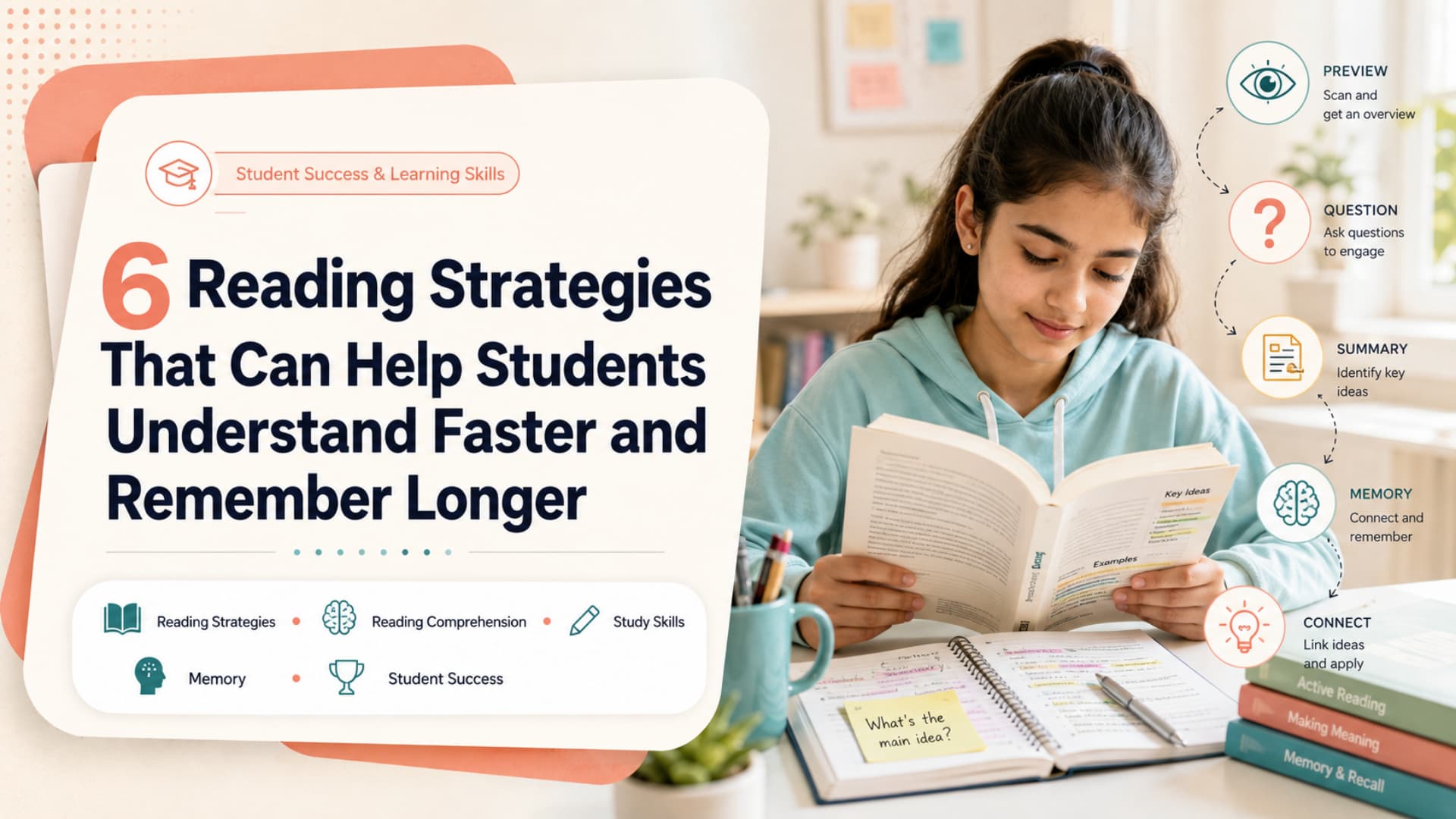
6 Reading Strategies That Can Help Students Understand Faster and Remember Longer
Reading Strategies • Reading Comprehension • Study Skills • Memory • Student Success
Many students read a chapter from beginning to end and still struggle to explain what they just studied.
The problem is not always reading speed.
Often, the real issue is passive reading.
Effective reading requires the brain to predict, question, connect, summarise and recall information.
The goal should not be:
“How quickly can I finish this chapter?”
It should be:
“How much can I understand, remember and use?”
Here are 6 reading strategies that can help students understand faster and remember longer.
________________________________________
1. Preview Before You Read
Do not immediately begin with the first paragraph.
First scan:
• Headings
• Subheadings
• Images
• Diagrams
• Bold words
• Summary boxes
• Questions
Why It Helps
Previewing gives your brain a basic map of what is coming.
When you begin reading, new information already has a structure to fit into.
Reading Tip
Spend one or two minutes asking:
“What is this chapter mainly about?”
Then start reading.
________________________________________
2. Turn Headings Into Questions
A heading should not just tell you what the section is called.
Turn it into a question.
For example:
Heading:
Causes of Climate Change
Question:
“What are the major causes of climate change?”
Now read the section looking for the answer.
Why It Helps
Questions give your attention a purpose.
Instead of simply moving your eyes across the page, you begin searching for meaning.
Read with a question in mind.
________________________________________
3. Read in Small Meaningful Sections
Do not rush through ten pages continuously.
Read one small section at a time.
After each section, stop.
Ask:
• What was the main idea?
• What new information did I learn?
• How does it connect with the previous section?
Why It Matters
Smaller sections reduce overload.
They also give the brain time to process information before more content arrives.
Reading Rule
Read → Pause → Understand → Continue
________________________________________
4. Summarise in Your Own Words
After reading a page or section, close the book and explain it simply.
Do not repeat textbook sentences.
Ask:
“How would I explain this to a friend?”
Why It Helps
Summarising forces you to identify the core meaning.
If you cannot explain the idea simply, you may need to read that part again.
Student Tip
Keep summaries short.
One paragraph may become only 2–3 important points.
________________________________________
5. Make Connections While Reading
New information becomes easier to understand when it connects with something you already know.
Ask:
• Does this remind me of another topic?
• Have I seen this in real life?
• What example can I think of?
• How is this different from something I already know?
Why It Helps
Connections create meaning.
Instead of storing isolated facts, your brain begins building a network of related ideas.
Memory Rule
Connected information is easier to understand and recall than isolated information.
________________________________________
6. Recall After You Finish
Finishing the final page does not mean the learning is complete.
Close the book.
Then write or say:
• Five main points
• Three important terms
• One concept you found difficult
• One question you could answer in an exam
Why It Helps
This combines reading with active recall.
You immediately discover what stayed in memory and what needs another review.
Use This Formula
Preview → Question → Read → Summarise → Recall
That turns ordinary reading into active learning.
________________________________________
The READER Formula
R — Review the Page First
Preview headings and visuals.
E — Establish Questions
Know what you are looking for.
A — Absorb in Small Sections
Do not overload yourself.
D — Describe in Your Own Words
Summarise the meaning.
E — Establish Connections
Link new and existing knowledge.
R — Recall Without Looking
Test what you remember.
________________________________________
Key Takeaway
Strong reading is not about moving through pages faster.
It is about reading with purpose.
Use:
Previewing • Questioning • Small Sections • Summarising • Connecting • Recalling
Instead of saying:
“I finished the chapter.”
ask:
“Can I explain the chapter without looking at it?”
That is a much stronger sign of learning.
Brain Gurukul Perspective
At Brain Gurukul, we believe reading becomes powerful when students move beyond simply seeing words and begin actively processing meaning.
Better reading supports comprehension, memory, independent learning and academic confidence.
Read actively. Understand deeply. Remember longer.
Read. Learn. Apply. Grow.
________________________________________
Blog Number: 48
Blog Name: 6 Reading Strategies That Can Help Students Understand Faster and Remember Longer
Word Count: ~760 words
Reading Strategies • Reading Comprehension • Study Skills • Memory • Student Success