
Parenting & Child Development
6 Simple Changes That Can Turn Your Home Into a Better Learning Environment
Home Learning • Parenting • Study Environment • Child Focus • Learning Habits
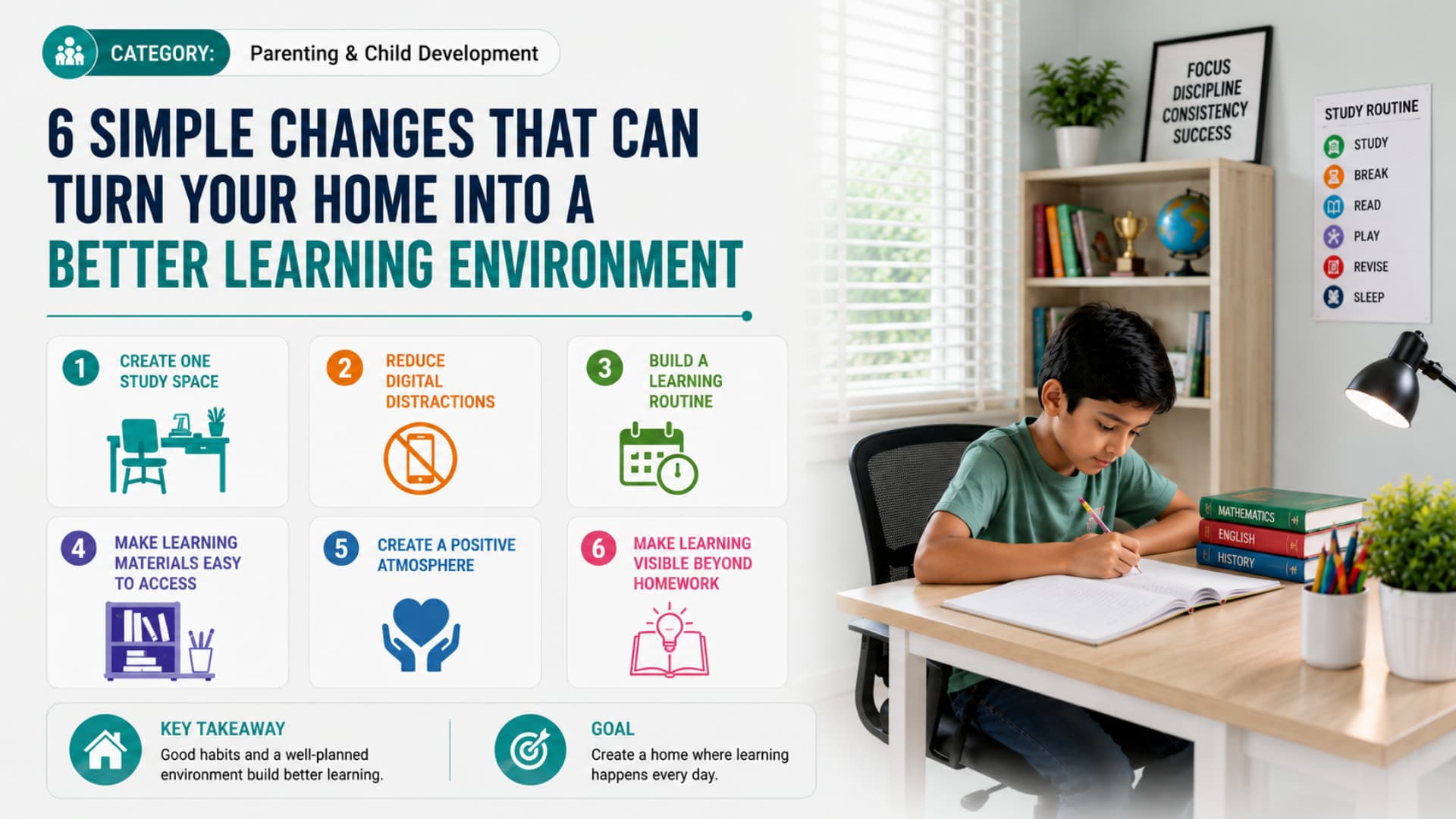
A child does not learn only at school.
The home environment also shapes how easily they can focus, practise, ask questions, revise and build learning habits.
The good news is that parents do not need an expensive study room or complicated setup.
A few simple changes can make home learning calmer, more organised and more effective.
Here are 6 practical ways to create a better learning environment at home.
________________________________________
1. Create One Consistent Study Space
Children often focus better when they have a familiar place for learning.
It could be:
• A study desk
• A quiet corner
• A dining-table section
• A small reading area
The space does not need to be large.
It simply needs to be comfortable, organised and relatively distraction-free.
Keep Nearby
Books • Notebook • Pens • Water • Required Device
Why It Matters
A consistent place helps create a mental association:
“When I sit here, it is time to learn.”
________________________________________
2. Reduce Visual and Digital Distractions
A cluttered desk, television, phone notifications and unrelated screens can constantly compete for attention.
Before study begins, simplify the environment.
Try This
• Keep the phone away
• Turn off unnecessary notifications
• Remove toys from the desk
• Close entertainment tabs
• Keep only the materials needed
Parent Tip
Do not expect children to constantly resist distractions that adults can easily remove.
Design the environment to support focus.
________________________________________
3. Build a Predictable Learning Routine
Children often work better when learning happens at a regular time.
For example:
Snack → Rest → Study → Break → Play
The exact schedule can vary between families.
What matters is consistency.
Why It Matters
A predictable routine reduces arguments and repeated reminders.
Instead of asking every day:
“When are you going to study?”
the child gradually knows when learning time begins.
Learning Rule
Routine reduces resistance.
________________________________________
4. Make Learning Materials Easy to Access
Starting becomes harder when children spend ten minutes searching for:
• Books
• Pencils
• Worksheets
• Chargers
• Notes
Organise basic materials so they are easy to find.
Simple Setup
Use:
• One stationery box
• Subject-wise folders
• A small bookshelf
• Labelled drawers
• A homework tray
Why It Matters
Reducing small obstacles makes it easier to start work.
A well-organised environment can also help children become more responsible for their own materials.
Organisation saves attention for learning.
________________________________________
5. Create a Positive Emotional Atmosphere
A study environment is not only physical.
It is also emotional.
If learning time is always associated with shouting, criticism or comparison, children may begin approaching study with anxiety.
Try a Better Approach
Use calm guidance.
Ask:
• What part is difficult?
• What have you understood?
• What should we try next?
• Where do you need help?
Why It Matters
Children often participate more willingly when mistakes feel safe to discuss.
This does not mean lowering expectations.
It means creating conditions where improvement is possible.
Remember
Support learning without turning every mistake into conflict.
________________________________________
6. Make Learning Visible Beyond Homework
A learning-friendly home should communicate that learning is part of everyday life—not only exam preparation.
Encourage:
• Reading together
• Asking questions
• Family discussions
• Puzzles
• Experiments
• Educational outings
• Creative activities
• Exploring new topics
Parents can also model curiosity by reading, learning and discussing ideas themselves.
Why It Matters
Children notice what adults value.
If learning is visible at home, children are more likely to see it as a normal part of life.
Parent Tip
Don't only ask:
“Have you finished your homework?”
sometimes ask:
“What interesting thing did you learn today?”
________________________________________
The HOME Formula
H — Have a Study Zone
Create one consistent place.
O — Organise the Space
Reduce clutter and distractions.
M — Maintain a Routine
Keep learning time predictable.
E — Encourage Learning
Create a positive and curious atmosphere.
________________________________________
Key Takeaway
A better learning environment does not require a bigger house or expensive furniture.
It needs:
Consistency • Organisation • Fewer Distractions • Positive Guidance • Curiosity
Small improvements in the environment can make it easier for children to focus and gradually manage learning more independently.
The goal is not to turn the home into another school.
It is to make home a place where learning feels natural, supported and possible.
Brain Gurukul Perspective
At Brain Gurukul, we believe strong learning habits grow when children receive both the right guidance and the right environment.
Create a better space for learning—and give better habits room to grow.
Read. Learn. Apply. Grow.
________________________________________
Blog Number: 32
Blog Name: 6 Simple Changes That Can Turn Your Home Into a Better Learning Environment
Word Count: ~760 words
Home Learning • Parenting • Study Environment • Child Focus • Learning Habits