
Student Success & Learning Skills
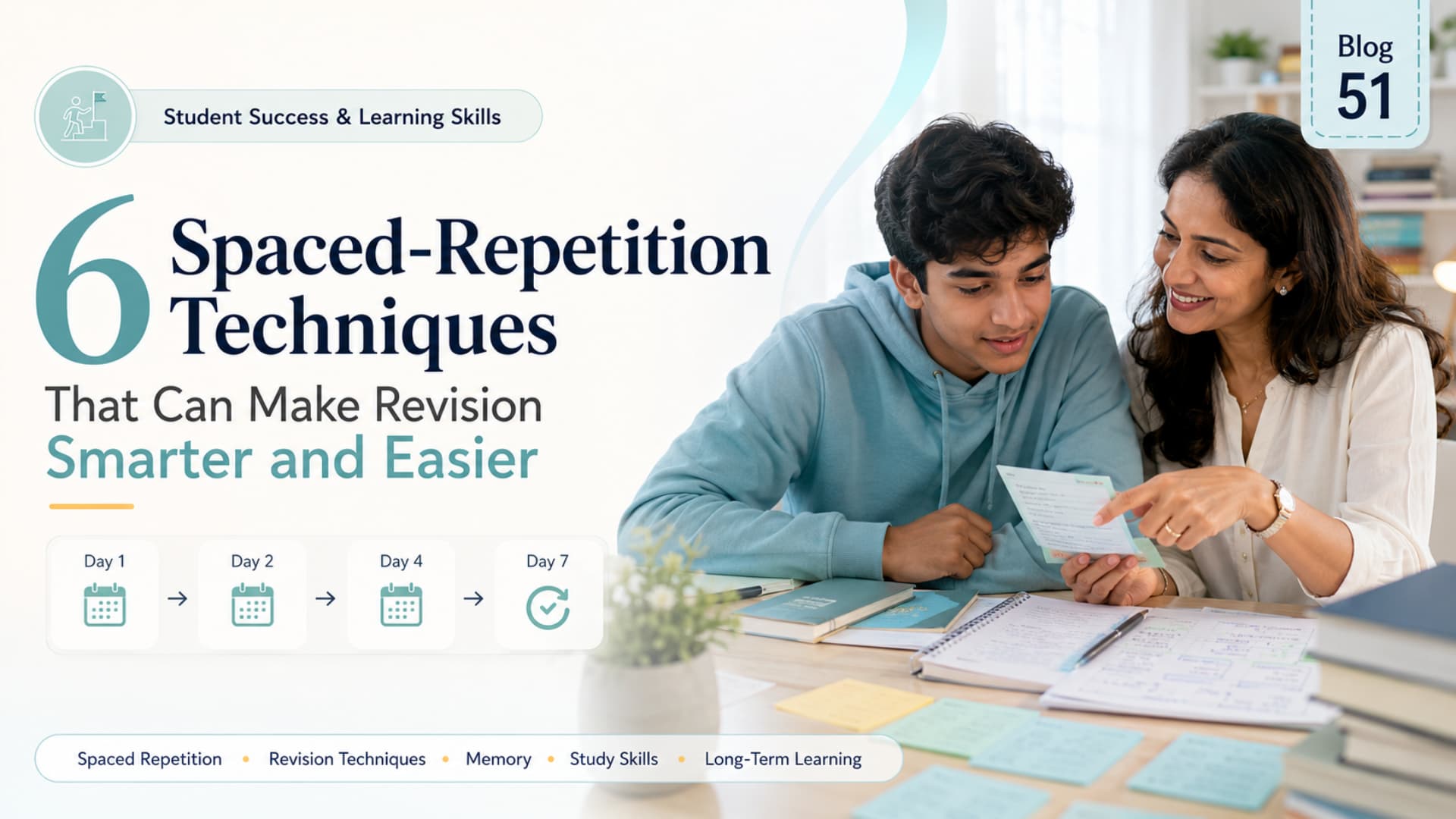
6 Spaced-Repetition Techniques That Can Make Revision Smarter and Easier
Spaced Repetition • Revision Techniques • Memory • Study Skills • Long-Term Learning
Have you ever revised a chapter thoroughly, felt confident about it—and then forgotten much of it a week later?
That happens because memory weakens when information is not revisited.
One of the smartest ways to improve retention is spaced repetition: reviewing information at planned intervals instead of trying to learn everything in one long session.
The goal is not:
“Revise everything again and again.”
It is:
“Review the right information at the right time.”
Here are 6 practical spaced-repetition techniques that can make revision smarter and easier.
________________________________________
1. Use the 1–2–4–7 Review Pattern
A simple revision schedule can make a big difference.
After learning an important topic, review it approximately:
Day 1 → Day 2 → Day 4 → Day 7
Later, extend the gap again if you still remember it well.
Why It Helps
Each successful recall gives the brain another opportunity to strengthen access to the information.
Study Tip
Do not completely relearn the chapter each time.
Use a short recall session instead.
________________________________________
2. Recall Before You Reopen the Book
When revision time arrives, resist the urge to immediately reread.
First ask yourself:
• What do I remember?
• What were the main points?
• Which formulas can I recall?
• What have I forgotten?
Then check your notes.
Why It Matters
This combines spaced repetition with active recall.
You are not simply seeing information again—you are practising retrieving it.
Use This Formula
Recall → Check → Correct → Review
________________________________________
3. Space Difficult Topics More Frequently
Not every topic needs the same revision schedule.
If something is easy to remember, you can increase the gap between reviews.
If something is difficult, revisit it sooner.
Example
Strong Topic:
Day 1 → Day 4 → Day 10
Weak Topic:
Day 1 → Day 2 → Day 4 → Day 7
Why It Helps
Your revision becomes personalised.
You spend more time where memory actually needs support.
Revision should follow your learning needs—not one fixed timetable.
________________________________________
4. Use Flashcards for Quick Spaced Reviews
Flashcards work well for information such as:
• Definitions
• Vocabulary
• Formulas
• Dates
• Concepts
• Question-answer pairs
Keep the question on one side and the answer on the other.
Better Method
Separate cards into:
Know Well • Need Practice • Difficult
Review difficult cards more frequently.
Why It Helps
This prevents you from wasting equal time on information you already know.
Study what needs attention most.
________________________________________
5. Build Spaced Revision Into Your Weekly Schedule
Do not leave revision to chance.
Add it to your timetable.
For example:
Monday: Learn Biology
Tuesday: Quick Biology recall
Thursday: Biology review
Sunday: Biology self-test
Why It Matters
Once revision becomes scheduled, it is less likely to be forgotten.
Even 10–15 focused minutes can be valuable.
Student Rule
Short revision repeated over time is often better than one exhausting revision session.
________________________________________
6. Increase the Gap When Recall Becomes Easier
Spaced repetition should gradually become more spaced.
If you remember something easily today, you may not need to review it again tomorrow.
Increase the interval.
For example:
1 Day → 3 Days → 7 Days → 14 Days → Longer
If recall becomes weak, shorten the gap again.
Why It Helps
This makes revision more efficient.
You focus effort where forgetting is most likely.
Remember
The purpose is not to revise constantly.
It is to revise strategically.
________________________________________
The SPACE Formula
S — Schedule Reviews
Plan revision in advance.
P — Practise Recall
Remember before looking.
A — Adjust the Intervals
Review difficult topics sooner.
C — Categorise Your Knowledge
Separate strong and weak areas.
E — Expand the Gap
Increase intervals as memory strengthens.
________________________________________
Key Takeaway
Spaced repetition changes revision from:
Last-Minute Cramming
into:
Planned Memory Strengthening
Use:
Short Reviews • Active Recall • Flexible Intervals • Flashcards • Weekly Scheduling
Instead of asking:
“How many times should I revise?”
ask:
“When should I revisit this so I can still recall it later?”
That is smarter revision.
Brain Gurukul Perspective
At Brain Gurukul, we believe effective learning depends not only on understanding information once, but also on being able to retrieve it when needed.
Spaced repetition helps students build a more systematic approach to revision and long-term recall.
Learn today. Revisit intelligently. Remember longer.
Read. Learn. Apply. Grow.
________________________________________
Blog Number: 51
Blog Name: 6 Spaced-Repetition Techniques That Can Make Revision Smarter and Easier
Word Count: ~770 words
Spaced Repetition • Revision Techniques • Memory • Study Skills • Long-Term Learning