Teachers, Schools & Education
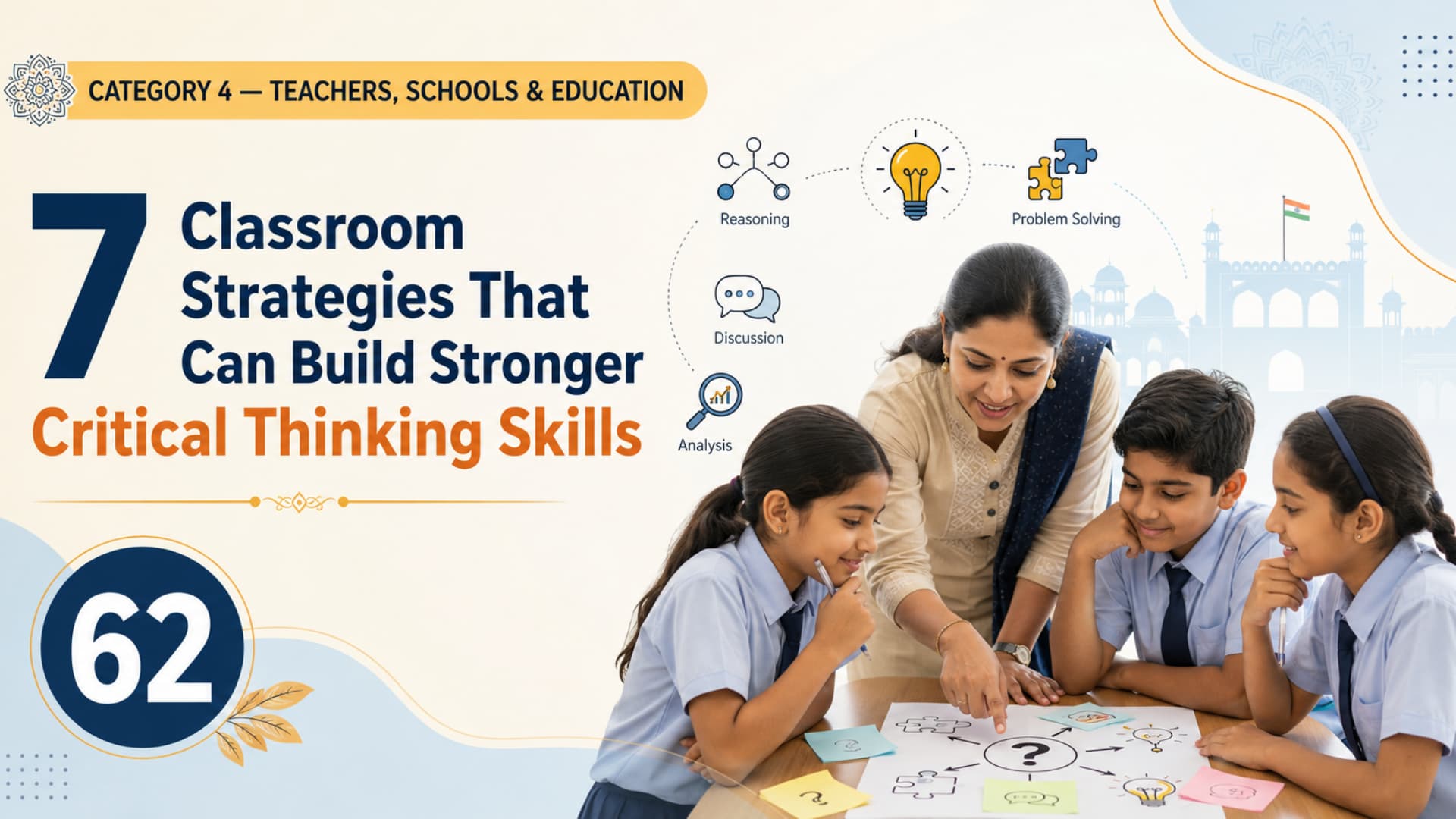
7 Classroom Strategies That Can Build Stronger Critical Thinking Skills
Critical Thinking • Classroom Strategies • Higher-Order Thinking • Teaching Skills • Student Learning
Critical thinking is not simply about finding the correct answer.
It is the ability to question, compare, analyse, evaluate and make reasoned decisions.
In many classrooms, students become used to memorising information and reproducing it in tests. But real learning becomes more powerful when students are encouraged to think beyond the textbook.
Here are 7 practical classroom strategies that can help build stronger critical thinking skills.
________________________________________
1. Ask More Open-Ended Questions
Avoid relying only on questions that have one short answer.
Instead, ask:
• Why do you think this happened?
• What evidence supports your answer?
• What could be another explanation?
• What might happen if one condition changed?
Why It Helps
Open-ended questions encourage students to think beyond recall.
Teaching Rule
Ask questions that require thinking, not just remembering.
________________________________________
2. Encourage Students to Explain Their Reasoning
A correct answer is useful.
But knowing how the student reached it is even more valuable.
Ask:
“How did you arrive at that answer?”
or
“What made you think that?”
Why It Helps
Students become more aware of their own thinking process.
It also helps teachers identify misunderstandings.
Classroom Habit
Answer + Reason = Better Thinking
________________________________________
3. Use Compare-and-Contrast Activities
Give students two ideas, events, methods or concepts to compare.
Ask them to identify:
• Similarities
• Differences
• Strengths
• Weaknesses
• Applications
Why It Helps
Comparison develops analysis.
Students begin looking at information from more than one angle.
Example
Instead of simply teaching two scientific processes separately, ask:
“How are they similar, and where do they differ?”
________________________________________
4. Present Real-Life Problems
Give students situations that require them to apply what they know.
For example:
• A maths budgeting problem
• An environmental challenge
• A social situation
• A science-based decision
• A classroom planning problem
Why It Helps
Real-life problems move students from:
Knowing → Applying → Analysing
Teacher Question
Ask:
“How can students use this idea in a real situation?”
________________________________________
5. Let Students Evaluate Different Answers
Sometimes there can be more than one reasonable approach.
Present two or three possible answers and ask:
• Which is strongest?
• Which has better evidence?
• What is missing?
• Which would you choose and why?
Why It Helps
Students learn that good thinking involves evaluating information, not simply accepting the first answer.
Thinking Skill
Compare → Judge → Justify
________________________________________
6. Use “What If?” Questions
Change one condition in a familiar situation.
Ask:
“What if this variable changed?”
“What if this event had not happened?”
“What if the rule were different?”
Why It Helps
“What if?” questions encourage prediction, flexibility and deeper understanding.
Students begin exploring possibilities rather than memorising fixed information.
Classroom Rule
Change the situation. Challenge the thinking.
________________________________________
7. Build Reflection Into Learning
After an activity or lesson, ask students:
• What did you learn?
• What changed your thinking?
• What evidence was most useful?
• What would you do differently?
• What question remains?
Why It Helps
Reflection helps students examine their own reasoning.
It strengthens the habit of thinking about how they think.
Reflection Loop
Think → Decide → Reflect → Improve
________________________________________
The THINK Formula
T — Test Ideas
Do not accept information automatically.
H — Hear Different Views
Consider alternative perspectives.
I — Investigate Evidence
Look for reasons and facts.
N — Notice Connections
Compare ideas and identify patterns.
K — Know Why
Explain and justify conclusions.
________________________________________
Key Takeaway
Critical thinking does not develop through lectures alone.
Students need regular opportunities to:
Question • Compare • Explain • Analyse • Apply • Evaluate • Reflect
These habits gradually help learners become more independent thinkers.
The goal is not only to teach students what to think, but to help them learn how to think.
Brain Gurukul Perspective
At Brain Gurukul, critical and analytical thinking are important parts of holistic intellectual development.
When students are encouraged to question, examine evidence, connect ideas and explain their reasoning, learning becomes deeper and more meaningful.
Teachers play a powerful role in creating classrooms where thinking is expected, supported and valued.
Question deeply. Think clearly. Decide wisely.
Read. Learn. Apply. Grow.
________________________________________
Blog Number: 62
Blog Name: 7 Classroom Strategies That Can Build Stronger Critical Thinking Skills
Word Count: ~760 words
Critical Thinking • Classroom Strategies • Higher-Order Thinking • Teaching Skills • Student Learning