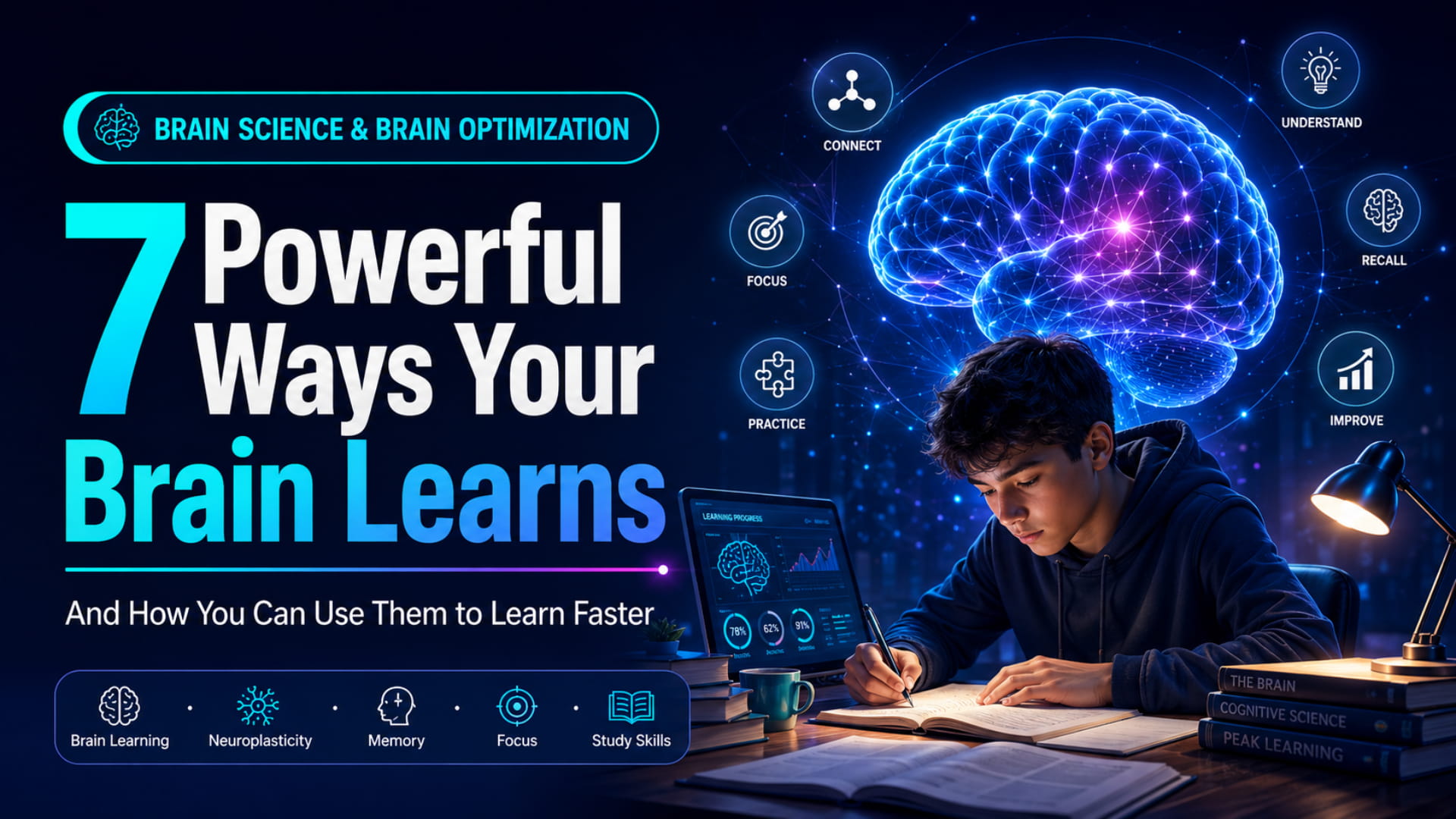
Brain Science & Brain Optimization
7 Powerful Ways Your Brain Learns — And How You Can Use Them to Learn Faster
Brain Learning • Neuroplasticity • Memory • Focus • Study Skills
Have you ever studied something for hours and forgotten it the next day—yet remembered a movie scene, conversation, or childhood experience for years?
The difference may not be how much information you received, but how your brain processed it.
Your brain does not simply store information like a computer. It connects, focuses, recalls, practises, creates meaning and strengthens learning through repeated experience.
Understanding these natural learning processes can help students—and adults—learn more intelligently.
Here are 7 powerful ways your brain learns and how you can use them every day.
____________________________________________________
1. Your Brain Learns Through Connections
New information becomes easier to understand when your brain can connect it with something already familiar.
For example, memorising the term “photosynthesis” may feel difficult. But connecting it with the simple idea of a plant using sunlight to prepare food makes the concept meaningful.
Try This
Whenever you learn something new, ask:
• What does this remind me of?
• What do I already know about it?
• Can I connect it with a real-life example?
Learning Rule:
Connect first. Remember better.
________________________________________
2. Your Brain Learns Through Focused Attention
Attention acts like a spotlight.
When you constantly switch between studying, notifications, social media and conversations, your attention gets divided.
Instead, create short periods of undistracted learning.
Try This
Choose one topic and work on it for 25–40 focused minutes.
Keep your phone away, close unnecessary tabs and define one clear goal.
Instead of:
"I am going to study science."
Try:
"I will understand one science concept and explain it in my own words."
Better attention creates better opportunities for learning.
________________________________________
3. Your Brain Learns Through Active Recall
Simply rereading something can make it look familiar—but familiarity does not always mean you can remember it later.
Active recall means deliberately trying to retrieve information from memory.
Research consistently shows that retrieval practice can strengthen long-term learning compared with passive review.
Use This Formula
Read → Close → Recall → Check
After reading a section, close the book and ask:
“What were the three most important points?”
Then check what you remembered.
This immediately transforms passive studying into active learning.
________________________________________
4. Your Brain Learns Better With Spaced Revision
Cramming everything into one long study session may help temporarily, but spacing learning across different sessions is generally more effective for longer-term retention.
Instead of revising a chapter for three hours once, try:
Day 1: Learn
Day 2: Quick recall
Day 3: Review again
Day 4: Self-test
Every revisit gives your brain another opportunity to retrieve and strengthen the information.
Learning Rule:
Don't just repeat—repeat over time.
________________________________________
5. Your Brain Learns Through Practice and Mistakes
You cannot learn swimming only by reading about swimming.
Skills improve when knowledge is used.
The same principle applies to mathematics, handwriting, communication, memory techniques, public speaking and problem-solving.
Use this learning loop:
Learn → Attempt → Mistake → Correct → Try Again
Instead of becoming frustrated by mistakes, ask:
“What is this mistake showing me?”
Mistakes can become valuable feedback when followed by correction and another attempt.
________________________________________
6. Your Brain Learns Better When Information Has Meaning
Meaningful information is easier to organise than disconnected facts.
That is why stories, visualisation, associations, examples and mnemonics can make learning easier.
Suppose you need to remember a difficult concept.
Don't only read the definition.
Visualise it.
Connect it.
Create an example.
Explain it in simple language.
The more meaning you create around information, the more ways your brain may have to access it later.
________________________________________
7. Your Brain Needs Rest to Support Learning
Studying longer does not automatically mean learning better.
Sleep plays an important role in learning and memory, and insufficient sleep can interfere with attention, memory and performance.
A smarter learning routine therefore includes:
Focused study + breaks + revision + adequate sleep
Your brain needs both effort and recovery.
________________________________________
The 7-Step Brain-Smart Learning Formula
Next time you study, remember:
CONNECT
Link new knowledge with something familiar.
FOCUS
Give one task your full attention.
RECALL
Retrieve information without looking.
SPACE
Review it again after a gap.
PRACTISE
Use what you learned.
CREATE MEANING
Use examples, stories and visualisation.
REST
Give your brain time to recover.
________________________________________
Key Takeaway
Learning faster does not necessarily mean studying faster.
It means learning in a way that works better with your brain.
Instead of asking:
“How many hours did I study?”
Start asking:
“How effectively did I learn?”
That simple change can transform your entire approach to learning.
Brain Gurukul Perspective
At Brain Gurukul, we believe effective learning begins with understanding how the brain learns, remembers, focuses and applies knowledge.
Because when learners understand how to learn, they become better prepared not only for exams—but for lifelong learning.
Learn how your brain learns—and learning itself becomes your advantage.
Read. Learn. Apply. Grow.
(WC=826)