
Parenting & Child Development
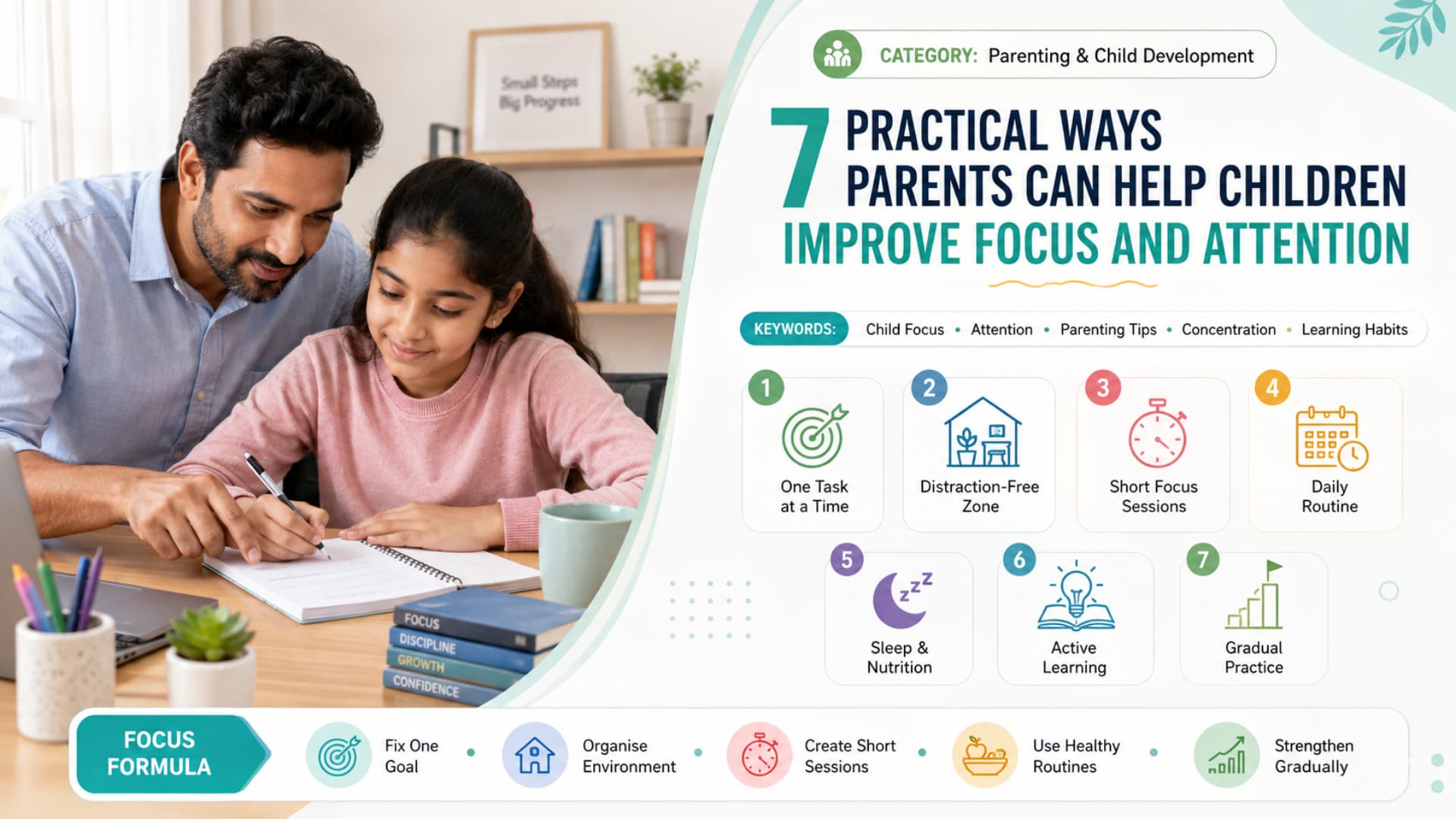
7 Practical Ways Parents Can Help Children Improve Focus and Attention
Child Focus • Attention • Parenting Tips • Concentration • Learning Habits
Does your child sit down to study but lose focus within a few minutes?
Maybe they start with homework, then look for a pencil, check something on a screen, begin another task, or simply drift into daydreaming.
This does not always mean the child is careless or unwilling to learn.
Focus can be affected by environment, sleep, task difficulty, interest, routines, stress and digital distractions.
Parents can help by creating better conditions for attention instead of repeatedly saying:
“Concentrate!”
Here are 7 practical ways to help children improve focus and attention.
________________________________________
1. Give One Clear Task at a Time
Long instructions can overwhelm children.
Instead of saying:
“Finish your maths, revise science, organise your bag and then read English.”
start with:
“Complete these five maths questions first.”
Why It Matters
A clear target gives the brain one direction.
Once the first task is complete, move to the next.
Parent Tip
Use:
One Task → Complete → Next Task
Simple instructions often produce better focus than long lists.
________________________________________
2. Create a Distraction-Free Study Zone
Children cannot be expected to ignore distractions that are constantly in front of them.
During study time, reduce:
• Television
• Mobile phones
• Unnecessary notifications
• Toys
• Background videos
• Unrelated conversations
Keep the workspace simple:
Books • Notebook • Pen • Water • Required Device
Why It Matters
Fewer competing stimuli make it easier for the child to stay with the task.
A better environment makes better focus easier.
________________________________________
3. Use Short Focus Sessions
Expecting a child to sit continuously for hours may reduce concentration rather than improve it.
Try shorter learning blocks.
For example:
25–30 minutes focused work → 5-minute break → Next session
Younger children may need even shorter periods.
During Breaks
Encourage:
• Stretching
• Walking
• Water
• Looking away from screens
Avoid turning every break into entertainment scrolling.
The purpose of a break is to refresh attention.
________________________________________
4. Build a Consistent Daily Routine
Children often focus better when they know what happens next.
A predictable routine can include:
School → Snack → Rest → Study → Play → Dinner → Reading → Sleep
The exact sequence can differ from family to family.
Why It Matters
Regular routines reduce unnecessary decision-making and arguments.
Over time, a fixed study period can become a familiar signal:
“Now it is time to focus.”
Consistency usually works better than daily negotiation.
________________________________________
5. Protect Sleep, Movement and Nutrition
Concentration does not begin at the study table.
A tired, hungry or inactive child may find focusing much harder.
Support the basics:
• Adequate sleep
• Regular meals
• Hydration
• Outdoor activity
• Physical movement
• Healthy bedtime routines
Parent Tip
Before assuming:
“My child cannot concentrate,”
also consider:
“Is my child physically and mentally ready to concentrate?”
Brain and body habits work together.
________________________________________
6. Make Learning More Active
Passive learning can quickly become boring.
Instead of only asking children to read, encourage them to:
• Explain the concept aloud
• Draw a diagram
• Solve a problem
• Make flashcards
• Teach you the topic
• Answer questions without looking
Why It Matters
Active learning gives the brain something to do, not just something to look at.
For example:
Instead of reading a chapter three times, ask:
“Tell me the five most important things you remember.”
That creates stronger engagement.
________________________________________
7. Train Focus Gradually
Focus is a skill.
Like other skills, it develops through practice.
If your child can currently work with good concentration for 15 minutes, do not suddenly demand 60 minutes.
Build gradually:
15 → 20 → 25 → 30 minutes
Celebrate improvement.
Avoid Labels
Do not repeatedly say:
“You are always distracted.”
Children can begin accepting such labels as part of their identity.
A better message is:
“Your focus is improving. Let's practise a little more.”
________________________________________
The FOCUS Formula
F — Fix One Goal
Give one clear task.
O — Organise the Environment
Reduce distractions.
C — Create Short Sessions
Use manageable focus periods.
U — Use Healthy Routines
Support sleep, movement and regular schedules.
S — Strengthen Gradually
Build attention through consistent practice.
________________________________________
Key Takeaway
Helping children focus does not require constant reminders or pressure.
Start by improving the conditions around learning:
Clear Tasks • Fewer Distractions • Short Sessions • Healthy Routines • Active Learning • Gradual Practice
The goal is not to demand perfect concentration.
It is to help the child become a little more focused and independent over time.
Brain Gurukul Perspective
At Brain Gurukul, we believe attention is one of the foundations of effective learning.
When parents create supportive routines and help children practise concentration gradually, learners become better prepared to understand, remember and apply what they study.
Don't just ask children to focus—help them build the ability to focus.
Read. Learn. Apply. Grow.
________________________________________
Blog Number: 27
Blog Name: 7 Practical Ways Parents Can Help Children Improve Focus and Attention
Word Count: ~785 words
Child Focus • Attention • Parenting Tips • Concentration • Learning Habits