Brain Science & Brain Optimization
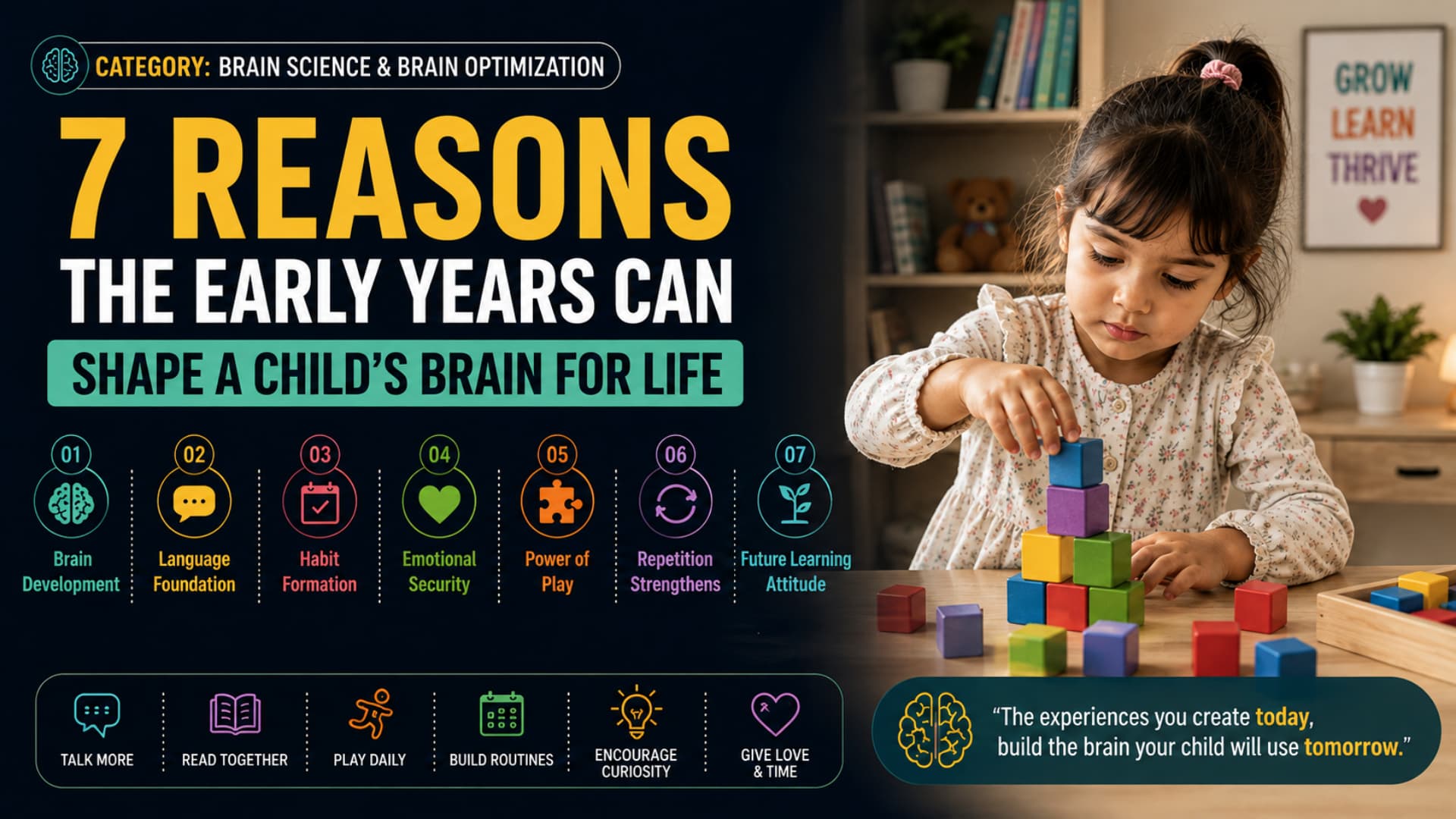
7 Reasons the Early Years Can Shape a Child’s Brain for Life
Early Brain Development • Childhood • Neuroplasticity • Learning • Parenting
The early years of childhood are not simply a time of physical growth.
They are also a period when the brain is developing at remarkable speed.
During these years, children are constantly absorbing language, emotions, habits, movement, relationships and experiences. The brain responds by building and strengthening neural pathways that support future learning and behaviour.
That is why the early years can influence far more than school readiness.
Here are 7 important reasons these years can shape a child’s brain for life.
________________________________________
1. The Brain Builds Connections Rapidly
Young children create huge numbers of neural connections as they interact with the world.
Every conversation, game, movement, story and experience gives the brain information to process.
Why It Matters
Rich experiences help the brain build stronger foundations for later learning.
Parents do not need complicated tools.
Simple activities such as talking, reading, playing and exploring can be extremely valuable.
Brain Tip:
Every meaningful experience gives the developing brain something to work with.
________________________________________
2. Language Experiences Build Communication Foundations
Children learn language by hearing and using it repeatedly.
Talking with children, asking questions, telling stories and reading aloud expose the brain to vocabulary, sentence patterns and meaning.
Why It Matters
Strong language exposure can support:
• Communication
• Understanding
• Reading
• Expression
• Confidence
Instead of only speaking to children, speak with them.
Conversation makes learning active.
________________________________________
3. Early Habits Begin to Shape Behaviour
Children learn routines long before they fully understand why those routines matter.
Repeated patterns such as:
• Regular sleep
• Reading time
• Keeping things organised
• Physical activity
• Healthy screen habits
• Completing simple responsibilities
gradually become familiar.
Why It Matters
Habits reduce the need to make the same decision again and again.
A positive routine practised early can become easier to maintain later.
Small habits today can become powerful patterns tomorrow.
________________________________________
4. Emotional Experiences Influence the Developing Brain
Children do not learn only through lessons.
They also learn through relationships.
Encouragement, safety, affection, boundaries and the way adults respond to mistakes can influence how children approach challenges.
Why It Matters
A child who feels supported is often more willing to explore, ask questions and try again after mistakes.
This does not mean removing every difficulty.
It means creating an environment where challenges can be faced with guidance rather than fear.
________________________________________
5. Play Develops More Than Entertainment
Play is one of childhood’s most natural learning tools.
Through play, children practise:
• Problem-solving
• Creativity
• Communication
• Movement
• Decision-making
• Social skills
A simple building-block activity can involve planning, imagination, coordination and persistence at the same time.
Why It Matters
Children often learn best when curiosity and action are involved.
Play allows the brain to practise several abilities together.
________________________________________
6. Repetition Strengthens Important Skills
A child rarely learns a skill perfectly on the first attempt.
Reading, handwriting, cycling, calculation and communication all improve through repetition.
Each meaningful repetition gives the brain another opportunity to refine the skill.
Why It Matters
Instead of expecting instant mastery, encourage:
Practice → Feedback → Correction → Repeat
Consistency is more useful than unnecessary pressure.
Development needs time.
________________________________________
7. Early Experiences Can Influence Future Learning Attitudes
Children begin forming beliefs about learning very early.
They may start thinking:
“I can figure this out.”
or:
“I am not good at this.”
The messages adults give can strongly influence these beliefs.
Instead of:
“You are naturally brilliant.”
try:
“You worked hard and found a better way.”
Instead of:
“You are bad at maths.”
try:
“You are still developing this skill.”
Why It Matters
Children who see ability as something that can develop may become more willing to practise, persist and learn from mistakes.
________________________________________
The ROOTS Formula
R — Relationships
Create safe, positive connections.
O — Opportunities
Give children varied learning experiences.
O — Organisation
Build healthy daily routines.
T — Thinking
Encourage curiosity, questions and problem-solving.
S — Support
Guide children through effort, mistakes and growth.
________________________________________
Key Takeaway
The early years do not determine every detail of a child’s future.
The brain continues developing and changing throughout life.
But early childhood provides an important foundation.
During these years, children are building patterns related to:
Learning • Language • Habits • Emotions • Behaviour • Confidence
The goal is not to create pressure for children to “achieve early.”
The better goal is to create the right environment for healthy development.
Brain Gurukul Perspective
At Brain Gurukul, we believe the early years should be used to nurture curiosity, strengthen learning abilities and build positive foundations for future development.
Because Brain Optimization is not about pushing children faster.
It is about helping them grow better.
Build strong roots today—and give the growing brain a stronger foundation for tomorrow.
Read. Learn. Apply. Grow.
________________________________________
Blog Number: 14
Blog Name: 7 Reasons the Early Years Can Shape a Child’s Brain for Life
Word Count: ~785 words
Early Brain Development • Childhood • Neuroplasticity • Learning • Parenting