Student Success & Learning Skills
7 Smart Self-Testing Techniques That Can Reveal What You Really Know
Self-Testing • Active Recall • Study Skills • Exam Preparation • Student Success
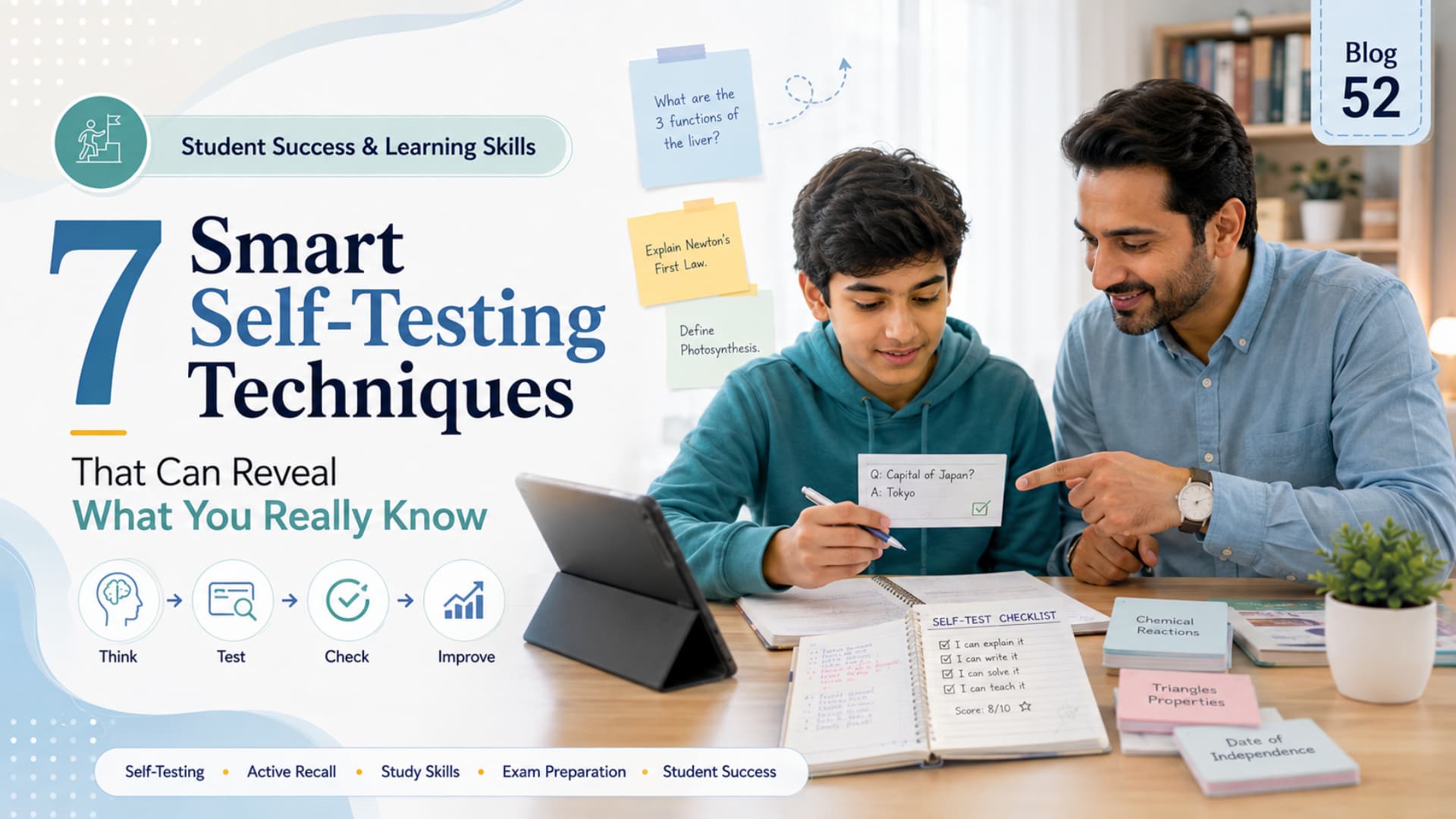
Many students mistake familiarity for learning.
They read a chapter several times, recognise the words and think:
“Yes, I know this.”
But recognition is not the same as recall.
The real test is simple:
Can you remember and use the information without looking at your notes?
That is where self-testing becomes powerful.
Self-testing helps students identify what they truly know, what they only recognise, and what still needs more practice.
Here are 7 smart self-testing techniques that can make your study sessions more effective.
________________________________________
1. Close the Book and Write What You Remember
After studying a topic, close the material completely.
Then write:
• Main ideas
• Important terms
• Formulas
• Examples
• Difficult points
Why It Helps
This immediately reveals the difference between:
“I saw it”
and
“I can recall it.”
Study Tip
Do not worry if you forget something.
The forgotten points show you exactly what to revise next.
________________________________________
2. Turn Your Notes Into Questions
Instead of reading notes again and again, convert them into questions.
For example:
Note: Photosynthesis requires sunlight.
Question: What role does sunlight play in photosynthesis?
Why It Helps
Questions force the brain to retrieve an answer.
Create short question lists after each topic and test yourself later.
Student Rule
Every important note can become a test question.
________________________________________
3. Use Flashcards Properly
Flashcards are useful only when you actually try to recall the answer before turning the card.
Use:
Front: Question or keyword
Back: Answer or explanation
Divide cards into:
• Know Well
• Need Practice
• Difficult
Why It Matters
You can spend more revision time on weaker areas instead of reviewing everything equally.
Remember
Do not flip too quickly. Think first. Check second.
________________________________________
4. Take Mini-Tests Without Notes
After finishing a topic, create a quick 10-minute test.
Include:
• Multiple-choice questions
• Short answers
• Definitions
• One application question
Then complete it without your notes.
Why It Helps
Mini-tests create a more realistic learning check.
They also help build confidence with:
Recall • Accuracy • Time Pressure
Study Tip
Test yourself before the exam tests you.
________________________________________
5. Explain the Answer Out Loud
Self-testing does not always require writing.
Choose a question and explain the answer aloud as if you were teaching someone.
Ask:
• Can I explain it clearly?
• Am I missing any steps?
• Can I give an example?
• Can I explain why it works?
Why It Matters
Speaking forces you to organise knowledge quickly.
If your explanation becomes unclear, you have discovered a gap.
Learning Rule
If you cannot explain it simply, revise it again.
________________________________________
6. Use a Confidence Score
After answering each question, rate your confidence:
3 — Very Sure
2 — Somewhat Sure
1 — Guessing
Then check the answer.
Why It Helps
Sometimes students are confidently wrong.
That is especially important to identify.
A wrong answer with high confidence needs immediate correction because the misunderstanding may be deeply established.
Student Tip
Track both:
Accuracy + Confidence
That gives a much clearer picture of learning.
________________________________________
7. Retest Mistakes Later
Do not simply correct a wrong answer and forget it.
Add it to a Retest List.
Review it again after:
1 Day → 3 Days → 7 Days
Why It Matters
A corrected answer may still be forgotten later.
Retesting helps ensure that the correction stays.
Use the Learning Loop
Test → Find Gap → Correct → Retest
This turns mistakes into useful learning information.
________________________________________
The TEST Formula
T — Try Without Notes
Retrieve from memory.
E — Examine Your Gaps
Find what you forgot.
S — Study the Weak Areas
Correct misunderstandings.
T — Test Again
Check whether learning improved.
________________________________________
Key Takeaway
Self-testing is not only for exams.
It should be part of learning itself.
Use:
Recall • Questions • Flashcards • Mini-Tests • Explanation • Confidence Scores • Retesting
Instead of asking:
“Have I studied this chapter?”
ask:
“Can I answer questions about it without looking?”
That is a much stronger measure of preparation.
Brain Gurukul Perspective
At Brain Gurukul, we believe students improve faster when they receive clear feedback about what they genuinely know and what still needs development.
Self-testing turns revision into an active process of discovery and improvement.
Test yourself. Find the gap. Fix it. Grow stronger.
Read. Learn. Apply. Grow.
________________________________________
Blog Number: 52
Blog Name: 7 Smart Self-Testing Techniques That Can Reveal What You Really Know
Word Count: ~775 words
Self-Testing • Active Recall • Study Skills • Exam Preparation • Student Success