Brain Science & Brain Optimization
7 Smart Ways to Train Your Brain for Better Speed, Focus and Mental Sharpness
Brain Training • Mental Sharpness • Focus • Cognitive Speed • Brain Performance

Can your brain become sharper with practice?
Yes—but not through shortcuts or one magical exercise.
Mental sharpness develops through a combination of focused attention, learning, memory practice, healthy routines, problem-solving and consistent challenge.
The goal is not to make the brain “work faster” at everything.
It is to help it become more efficient at processing, focusing, remembering and responding.
Here are 7 smart ways to train your brain for better speed, focus and mental sharpness.
________________________________________
1. Practise Focused Attention
The brain performs better when attention is directed toward one task.
Constant switching between messages, videos, conversations and work can weaken the quality of concentration.
Try This
Create a 30-minute focus block:
• Choose one task
• Keep your phone away
• Close unnecessary tabs
• Work without switching
• Take a short break afterward
Why It Helps
Repeated focused practice helps you become more comfortable with sustained attention.
Brain Tip:
Strong focus is trained one distraction-free session at a time.
________________________________________
2. Challenge Your Brain With Something New
Doing only familiar activities keeps you comfortable.
Learning something new creates a fresh challenge.
Try:
• A new language
• Mental maths
• Chess
• Music
• Coding
• Puzzles
• A new professional skill
Why It Matters
New learning forces the brain to pay attention, recognise patterns and develop new strategies.
The challenge should be difficult enough to make you think—but not so difficult that you immediately give up.
Challenge creates opportunity for growth.
________________________________________
3. Strengthen Your Memory Through Recall
Rereading information again and again can feel productive.
A stronger strategy is to retrieve information from memory.
After studying, close the material and ask:
• What did I just learn?
• What were the main points?
• Can I explain them without looking?
Use This Formula
Learn → Close → Recall → Check
This makes memory active instead of passive.
The brain gets better at retrieving information when retrieval is practised.
________________________________________
4. Train Processing Through Timed Practice
Some skills become faster when practised regularly.
Examples include:
• Mental calculations
• Reading familiar material
• Keyboard typing
• Handwriting
• Pattern recognition
• Basic problem-solving
Important Rule
Do not sacrifice accuracy just to become faster.
First build:
Correctness → Confidence → Speed
Then gradually challenge yourself with timed practice.
Why It Helps
Repeated performance can make familiar processes more efficient.
Speed should grow from mastery—not rushing.
________________________________________
5. Use Problem-Solving Every Day
Problem-solving trains the brain to analyse information and consider alternatives.
You do not need complicated exercises.
Try:
• Logic puzzles
• Strategy games
• Real-world planning
• Mathematical problems
• Comparing two solutions
• Asking “What else could work?”
Why It Matters
Good thinkers do not simply remember answers.
They learn how to find answers.
This supports flexibility, reasoning and decision-making.
________________________________________
6. Move Your Body to Support Your Brain
Brain training should not happen only while sitting at a desk.
Physical activity supports overall brain and body health.
Try:
• Walking
• Cycling
• Sports
• Yoga
• Dancing
• Outdoor activities
Why It Matters
Movement can support alertness, energy and mental well-being.
A tired, inactive body can make focused thinking more difficult.
Brain Tip
Train the body and brain together.
________________________________________
7. Protect Sleep and Recovery
One of the biggest mistakes in performance culture is treating rest as wasted time.
The brain needs recovery.
Poor sleep can affect:
• Attention
• Memory
• Reaction time
• Mood
• Decision-making
Build a Better Routine
Combine:
Focused practice + physical movement + breaks + adequate sleep
instead of:
Long hours + constant stimulation + exhaustion
Mental sharpness is not created only during effort.
Recovery matters too.
________________________________________
The SHARP Formula
S — Single-Task
Focus deeply on one activity.
H — Handle New Challenges
Keep learning.
A — Activate Memory
Use recall regularly.
R — Reason and Respond
Practise problem-solving and timed skills.
P — Protect Brain Health
Move, rest and sleep well.
________________________________________
Key Takeaway
A sharper brain does not come from one technique.
It comes from a system of small habits:
Focus better.
Learn new things.
Recall actively.
Practise consistently.
Solve problems.
Stay active.
Recover properly.
Do these regularly and you create stronger conditions for better mental performance.
Brain Gurukul Perspective
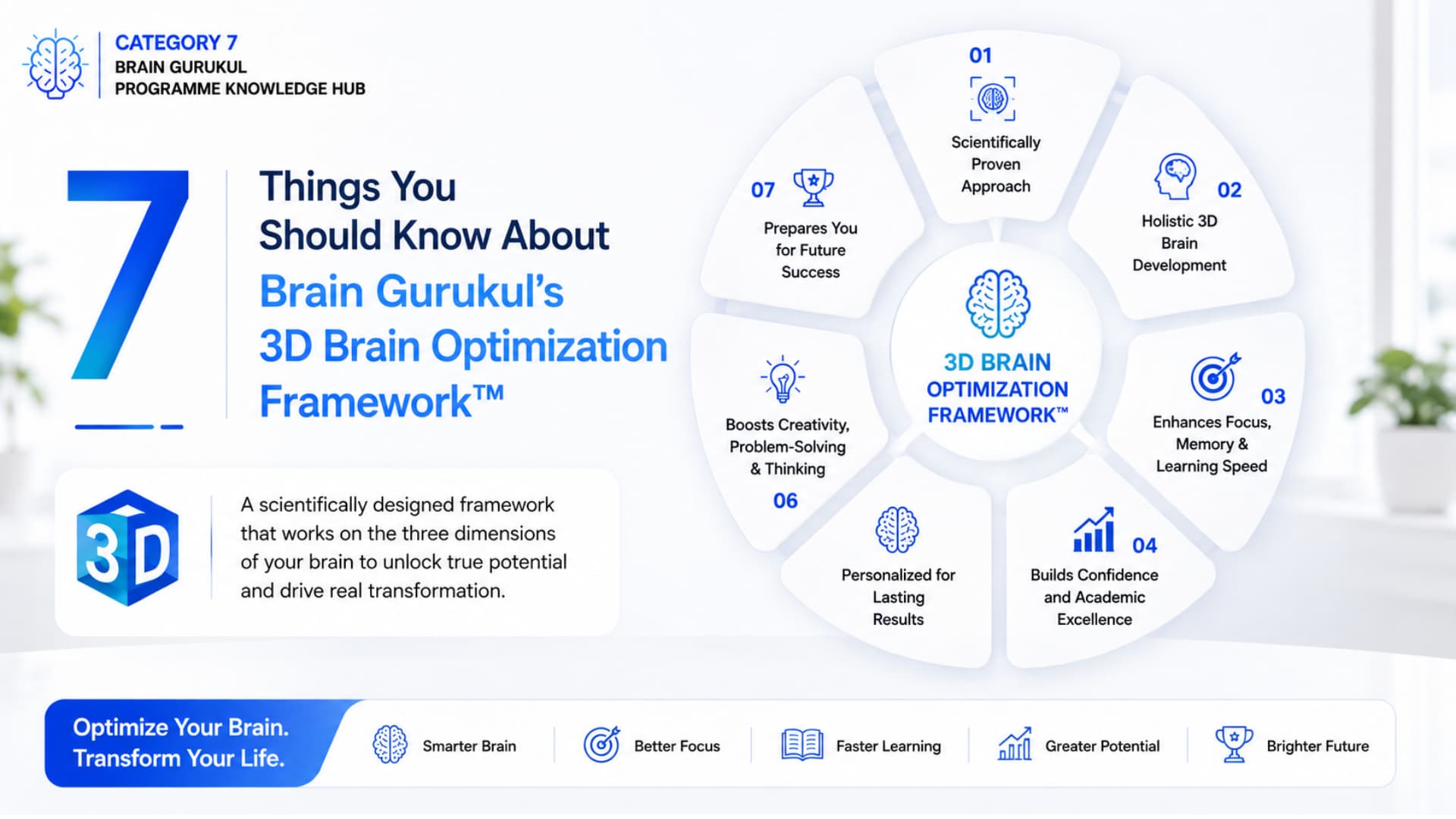
At Brain Gurukul, we believe Brain Optimization is about developing abilities systematically rather than chasing overnight results.
The objective is to help learners strengthen focus, memory, thinking, learning agility and mental performance through consistent practice.
Train your brain intelligently—and give your abilities room to grow.
Read. Learn. Apply. Grow.
________________________________________
Blog Number: 19
Blog Name: 7 Smart Ways to Train Your Brain for Better Speed, Focus and Mental Sharpness
Word Count: ~785 words
Brain Training • Mental Sharpness • Focus • Cognitive Speed • Brain Performance