
Brain Gurukul Programme Knowledge Hub
7 Speed-Reading Techniques That Can Help You Process Information More Efficiently
Speed Reading • Reading Efficiency • Comprehension • Learning Skills • Brain Gurukul
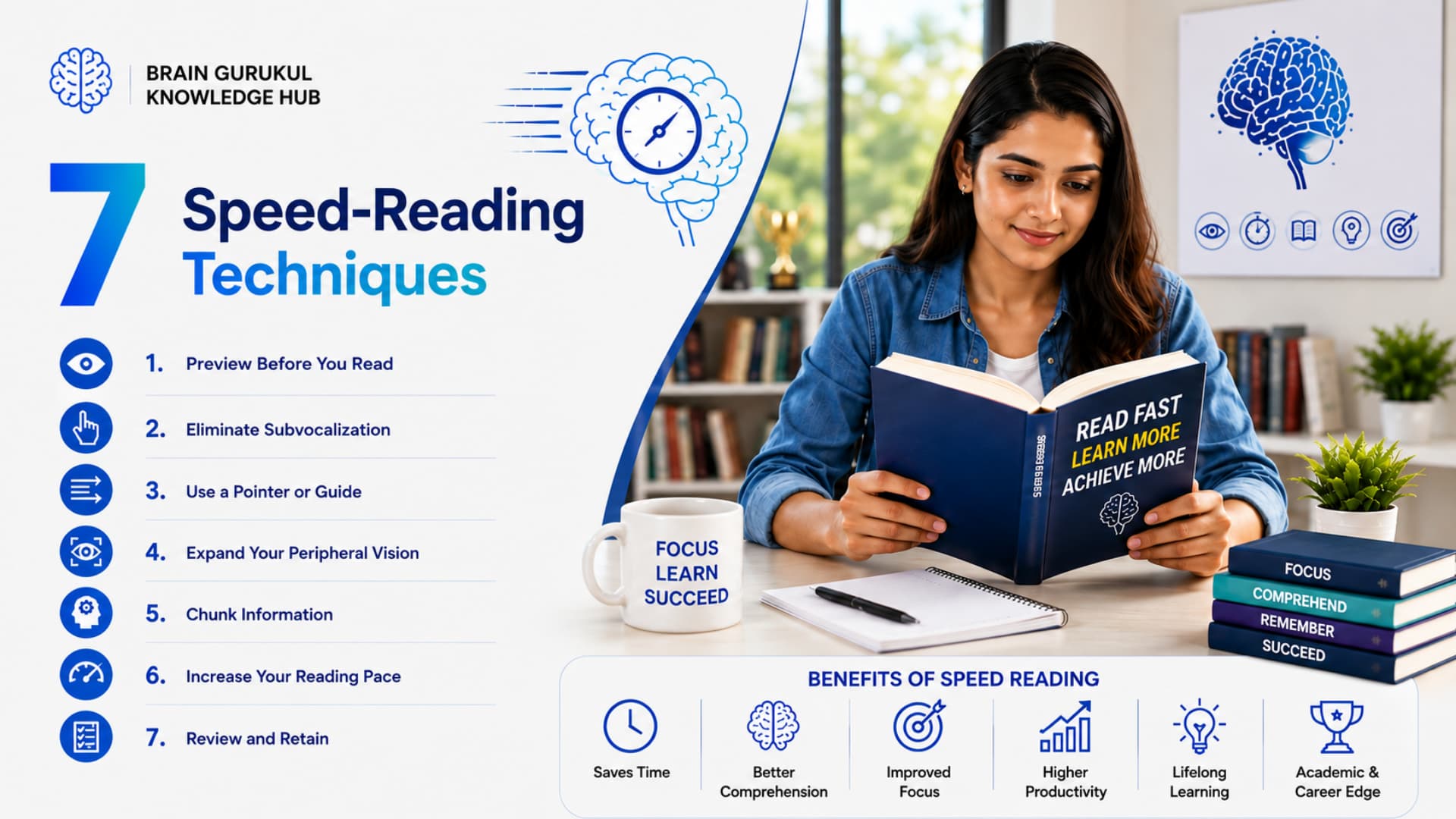
Reading more quickly can be useful—but only if understanding remains strong.
Effective speed reading is not about rushing through pages. It is about reducing inefficient reading habits, improving visual flow and learning how to adjust your pace according to the material.
Here are 7 practical speed-reading techniques that can help you process information more efficiently.
________________________________________
1. Preview Before You Read
Before starting a chapter or article, quickly scan:
• Headings
• Subheadings
• Bold words
• Diagrams
• Summary points
• Questions
Why It Helps
Previewing gives your brain a basic structure of the topic before detailed reading begins.
Reading Rule
Preview first. Read with direction.
________________________________________
2. Read in Phrases, Not One Word at a Time
Slow readers often process every word separately.
Instead of:
The → student → learns → through → repeated → practice
try reading:
The student learns → through repeated practice
Why It Helps
Reading in meaningful word groups can reduce unnecessary eye stops.
Student Tip
See phrases. Process meaning.
________________________________________
3. Use a Visual Guide
A finger, pen or pointer can help guide the eyes smoothly across the page.
Move it steadily under the line while reading.
Why It Helps
A visual guide may reduce:
• Losing your place
• Unnecessary backtracking
• Wandering attention
• Irregular reading pace
Reading Principle
Guide the eyes. Maintain the rhythm.
________________________________________
4. Reduce Unnecessary Re-Reading
Many readers repeatedly move backward because they are unsure whether they understood a sentence.
Occasional re-reading is useful.
Constant re-reading can slow the entire process.
Try This
Finish the paragraph first.
Then ask:
“What was the main idea?”
Go back only if understanding is genuinely unclear.
Why It Helps
This improves forward reading flow and encourages active concentration.
________________________________________
5. Adjust Speed According to Difficulty
Not every part of a text deserves the same reading pace.
Read faster through:
• Familiar explanations
• Examples
• Repeated ideas
• Simple descriptions
Slow down for:
• Definitions
• Technical concepts
• Formulas
• Complex arguments
• Important details
Why It Matters
Effective readers change speed according to purpose.
Reading Rule
Easy material → faster.
Complex material → slower.
________________________________________
6. Pause and Recall Key Ideas
After a section, pause briefly.
Ask:
• What was the main point?
• What did I learn?
• What do I remember?
• What was important?
Why It Helps
Recall checks whether speed is reducing comprehension.
Learning Loop
Read → Pause → Recall → Continue
________________________________________
7. Practise With Comprehension Checks
Speed improves through regular practice.
Choose suitable reading material and practise for 10–15 minutes.
Track:
• Time taken
• Amount read
• Main ideas remembered
• Questions answered correctly
Why It Helps
This prevents learners from chasing speed alone.
Student Rule
Measure understanding along with speed.
________________________________________
The RAPID Formula
R — Review First
Preview the material.
A — Absorb in Phrases
Read meaningful word groups.
P — Pace Your Eyes
Use smooth visual movement.
I — Interpret as You Read
Keep understanding active.
D — Develop Through Practice
Improve gradually and consistently.
________________________________________
Key Takeaway
Speed reading works best when it combines:
Visual Efficiency • Attention • Flexible Pace • Comprehension • Recall • Practice
The goal is not to move through words faster. The goal is to process useful information more efficiently.
Brain Gurukul Perspective
At Brain Gurukul, speed reading is positioned within the DESIGN stage of the 3D Brain Optimization Framework™.
The focus is on helping learners improve reading efficiency while maintaining meaningful comprehension and recall.
Speed should always support understanding—not replace it.
Read faster. Understand clearly. Process smarter.
Read. Learn. Apply. Grow.
________________________________________
Blog Number: 112
Blog Name: 7 Speed-Reading Techniques That Can Help You Process Information More Efficiently
Word Count: ~735 words
Speed Reading • Reading Efficiency • Comprehension • Learning Skills • Brain Gurukul