
Student Success & Learning Skills
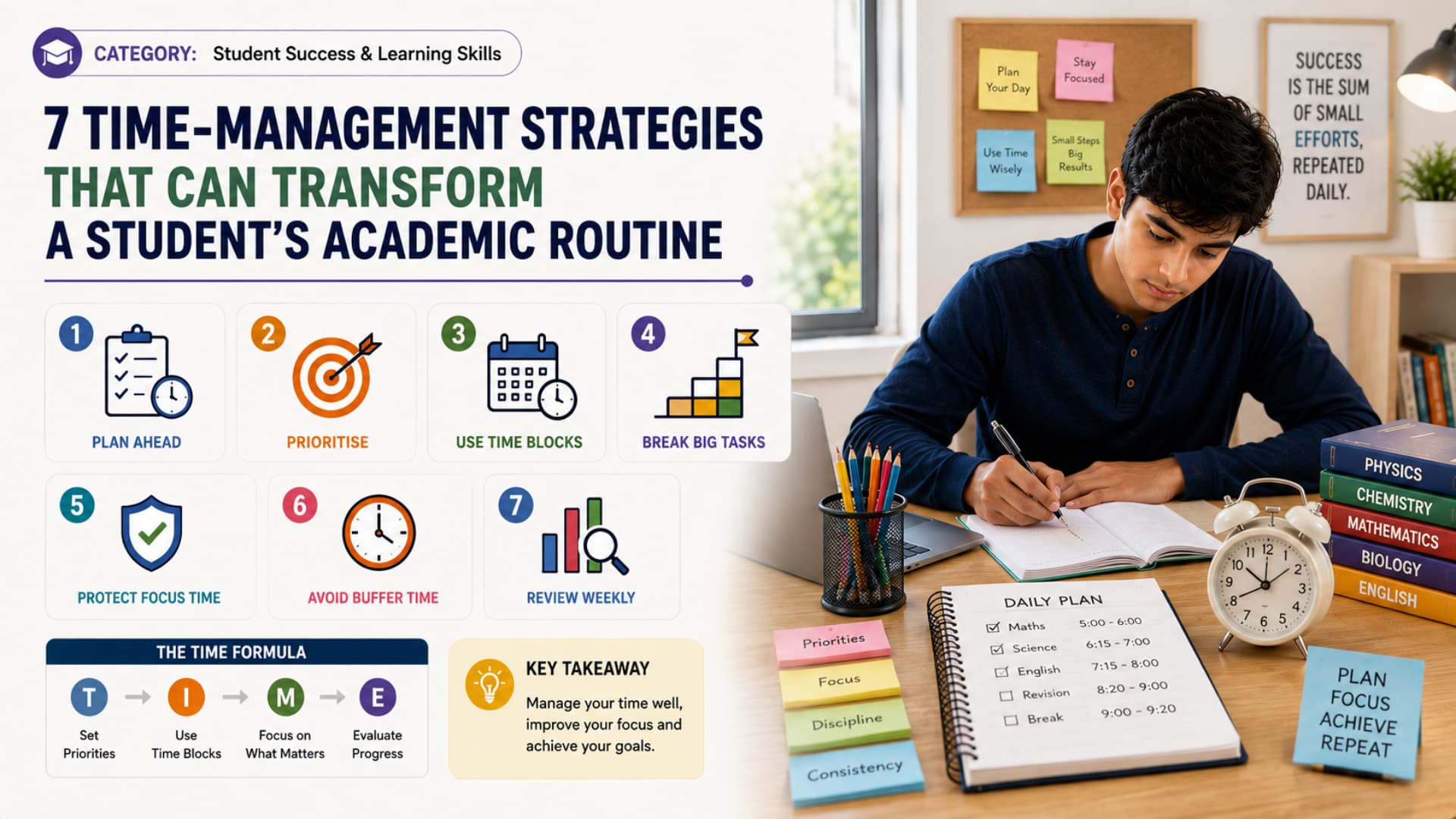
7 Time-Management Strategies That Can Transform a Student’s Academic Routine
Time Management • Study Routine • Student Success • Productivity • Academic Planning
Most students do not struggle because they have too little time.
They struggle because their time is unplanned, fragmented or constantly interrupted.
Homework, revision, school projects, activities, screens and rest can quickly compete with one another.
The solution is not to make every minute rigid.
It is to create a simple system that helps students know:
What to do, when to do it and what matters most.
Here are 7 time-management strategies that can transform a student’s academic routine.
________________________________________
1. Plan Tomorrow Before Today Ends
Do not begin each day wondering:
“What should I study first?”
Take five minutes every evening to list the most important tasks for the next day.
For example:
• Complete maths homework
• Revise science chapter
• Practise English writing
• Prepare school bag
Why It Helps
Planning in advance reduces confusion and saves time.
Study Tip:
Tomorrow becomes easier when it is organised today.
________________________________________
2. Prioritise Important Tasks First
Not every task has equal importance.
Separate work into:
Must Do
Urgent homework, tests, deadlines.
Should Do
Revision, practice, project progress.
Can Do
Optional activities or lower-priority work.
Why It Matters
Students often spend time on easy tasks while important work keeps getting delayed.
Ask:
“What will create the biggest problem if I do not complete it today?”
Start there.
________________________________________
3. Use Time Blocks
Instead of studying randomly, assign a specific period to each task.
Example:
5:00–5:30 — Mathematics
5:30–5:40 — Break
5:40–6:10 — Science
6:10–6:25 — Revision
Why It Helps
Time blocks create clear boundaries.
Students know when to begin, when to stop and what should be completed.
Learning Rule
Give every important task a place in your day.
________________________________________
4. Break Large Tasks Into Smaller Steps
“Complete the project” can feel overwhelming.
Instead, break it into:
1. Research topic
2. Collect information
3. Create outline
4. Write first draft
5. Review and finish
Why It Matters
Smaller tasks are easier to schedule and complete.
They also reduce procrastination because the first step feels manageable.
Study Tip
Do not manage the whole mountain. Manage the next step.
________________________________________
5. Protect Your Focus Time
A perfect timetable is useless if every study session is interrupted.
During planned study time:
• Keep the phone away
• Turn off unnecessary notifications
• Avoid social media
• Close unrelated tabs
• Focus on one task
Why It Matters
Frequent interruptions can make a 30-minute task take much longer.
Protecting attention also protects time.
Remember
Time management and attention management go together.
________________________________________
6. Keep Buffer Time
Students often plan every minute too tightly.
Then one delayed task destroys the entire schedule.
Leave some flexible time between activities.
For example:
If an assignment should take 30 minutes, allow 35–40 minutes.
Why It Helps
Buffer time gives room for:
• Difficult questions
• Unexpected homework
• Travel delays
• Short rest
• Tasks taking longer than expected
A realistic timetable is more useful than a perfect-looking timetable.
________________________________________
7. Review Your Week
Good time management improves through reflection.
At the end of the week, ask:
• What did I complete?
• What kept getting delayed?
• Where did I waste time?
• When was my focus strongest?
• What should I change next week?
Why It Matters
A timetable should not remain fixed if it is not working.
Adjust it according to real experience.
Student Rule
Plan → Follow → Review → Improve
That is how routines become practical.
________________________________________
The TIME Formula
T — Target Priorities
Know what matters most.
I — Insert Time Blocks
Give tasks a specific place.
M — Make Tasks Smaller
Break large work into steps.
E — Evaluate Progress
Review and improve your routine.
________________________________________
Key Takeaway
Time management is not about filling every hour with work.
It is about using your available time with greater intention.
Build your routine around:
Priorities • Planning • Focus • Small Steps • Flexibility • Review
Instead of asking:
“Do I have enough time?”
ask:
“Am I using my available time well?”
That question can completely change your academic routine.
Brain Gurukul Perspective
At Brain Gurukul, we believe strong students need more than knowledge.
They also need the ability to organise themselves, manage priorities and use learning time effectively.
Plan better. Focus better. Use time better. Perform better.
Read. Learn. Apply. Grow.
________________________________________
Blog Number: 42
Blog Name: 7 Time-Management Strategies That Can Transform a Student’s Academic Routine
Word Count: ~760 words
Time Management • Study Routine • Student Success • Productivity • Academic Planning