
Parenting & Child Development
7 Ways to Support a Child Who Is Struggling Academically Without Increasing Pressure
Academic Struggle • Parenting Support • Child Confidence • Study Habits • Learning Difficulties
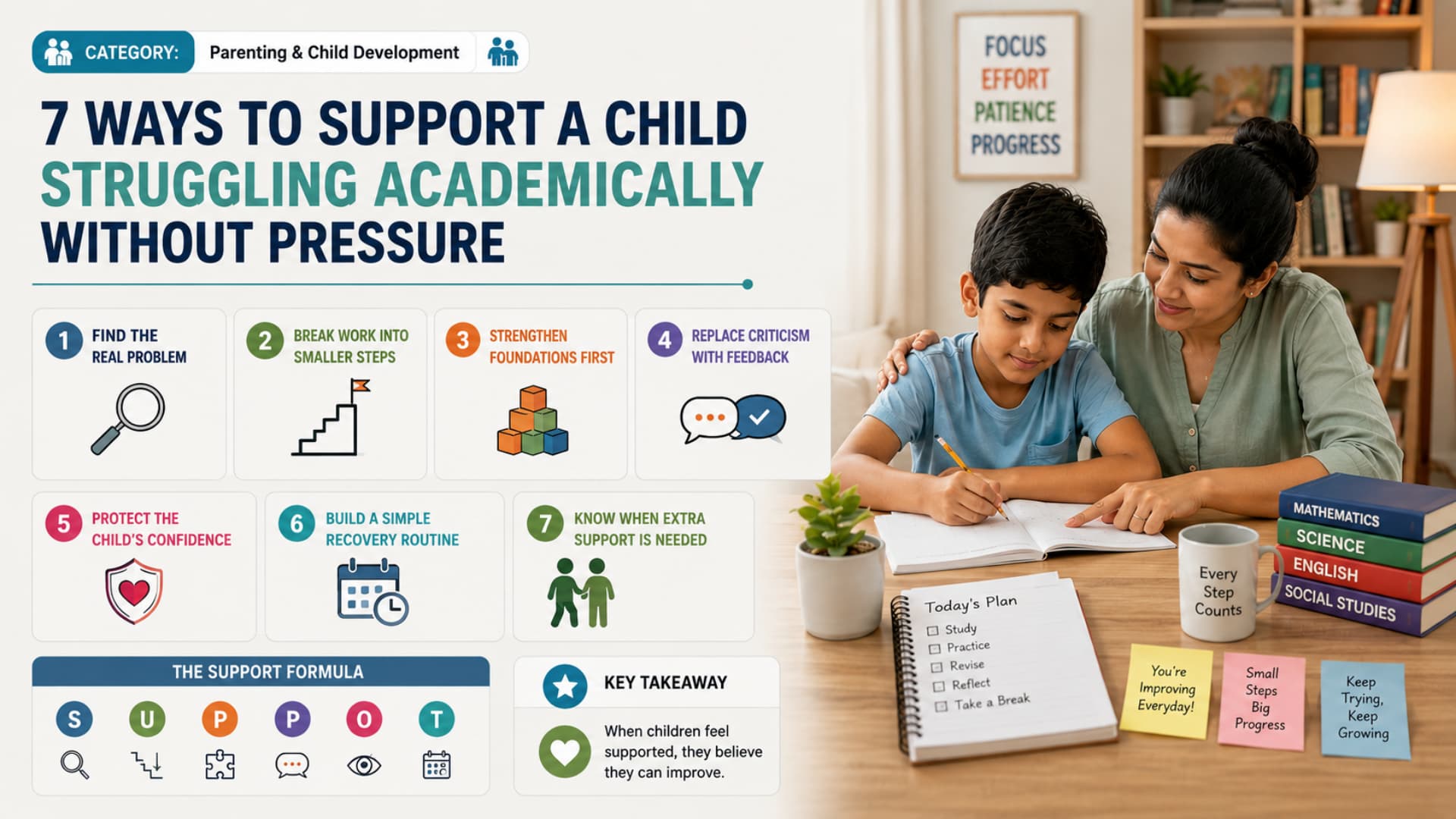
When a child begins struggling academically, many parents naturally increase pressure.
More reminders.
More study hours.
More criticism.
More comparisons.
But pressure does not always solve the real problem.
A child may be struggling because of weak foundations, poor study habits, low confidence, attention difficulties, stress, lack of practice or simply because the learning method is not working well.
The better approach is to first understand why the struggle is happening.
Here are 7 practical ways parents can support a struggling learner without making learning feel heavier.
________________________________________
1. Find the Real Problem Before Increasing Study Time
Low marks do not always mean lack of effort.
Ask:
• Is the concept unclear?
• Are basic skills weak?
• Is the child distracted?
• Is revision irregular?
• Is confidence low?
• Is the workload overwhelming?
Why It Matters
If multiplication is weak, practising difficult division for longer may not solve the problem.
Sometimes the real need is to repair the foundation first.
Parent Tip
Before saying:
“Study more.”
ask:
“What exactly needs improvement?”
________________________________________
2. Break Difficult Work Into Smaller Steps
A large chapter or assignment can make a struggling child feel defeated before starting.
Break the task down.
Instead of:
“Complete the entire chapter.”
try:
1. Understand one concept.
2. Solve three questions.
3. Check mistakes.
4. Take a short break.
5. Continue.
Why It Matters
Small victories create momentum.
The child begins experiencing:
“I can do this.”
That feeling is important for rebuilding confidence.
________________________________________
3. Strengthen Foundations Before Moving Ahead
Children often struggle with advanced topics because earlier concepts were never fully understood.
For example:
• Weak phonics can affect reading.
• Weak multiplication can affect division.
• Poor vocabulary can affect comprehension.
Better Approach
Identify the missing foundation and strengthen it first.
Why It Matters
Repeatedly pushing forward without fixing gaps can make the child feel incapable.
Sometimes going one step backward creates faster progress forward.
________________________________________
4. Replace Criticism With Useful Feedback
Statements such as:
“You never concentrate.”
or
“You are careless.”
do not tell the child what to improve.
Use specific feedback instead.
Try:
“You understood the method, but you skipped one step.”
or
“Let's practise these three questions again.”
Why It Matters
Useful feedback gives direction.
Criticism gives judgement.
Parent Rule
Correct the problem—not the child’s identity.
________________________________________
5. Protect the Child’s Confidence
Academic struggle can quickly become:
“I am bad at studies.”
That belief can reduce effort further.
Parents should recognise progress, even when improvement is small.
Say:
• “You completed more today.”
• “Your accuracy improved.”
• “You remembered this concept.”
• “You kept trying.”
Why It Matters
Confidence does not require false praise.
It grows when children can see genuine progress.
Progress builds belief. Belief supports effort.
________________________________________
6. Build a Simple Recovery Routine
A struggling learner often needs structure more than extra pressure.
Try:
20–30 minutes focused learning
→ Short break
→ 10 minutes recall
→ Quick practice
→ Stop positively
Use regular revision rather than last-minute cramming.
Why It Matters
A predictable routine makes learning feel more manageable.
Consistency usually helps more than occasional long study sessions.
Parent Tip
Focus on daily improvement, not emergency preparation before exams.
________________________________________
7. Know When Extra Support Is Needed
Parents cannot solve every learning difficulty alone.
If a child continues struggling despite consistent support, it may be useful to speak with:
• Teachers
• School counsellors
• Qualified learning specialists
• Other appropriate professionals
Why It Matters
Getting support early can help identify whether the child needs:
• Foundation repair
• Different teaching strategies
• Additional practice
• Emotional support
• More specialised assessment
Seeking guidance is not overreacting.
It is part of understanding what the learner needs.
________________________________________
The SUPPORT Formula
S — See the Real Problem
Identify the cause.
U — Use Smaller Steps
Make learning manageable.
P — Patch Foundation Gaps
Strengthen missing basics.
P — Provide Useful Feedback
Guide instead of criticising.
O — Observe Progress
Celebrate genuine improvement.
R — Routine Matters
Build consistent learning habits.
T — Take Help When Needed
Use the right support at the right time.
________________________________________
Key Takeaway
When a child struggles academically, the answer is not always more pressure.
Often, the better answer is:
Better Understanding • Smaller Steps • Stronger Foundations • Useful Feedback • Consistent Support
The goal is not to make the child study in fear.
It is to help the child regain:
Clarity • Confidence • Capability
Brain Gurukul Perspective
At Brain Gurukul, we believe struggling learners should first be understood, not labelled.
When the real learning gap is identified and the right support is provided, children gain a better opportunity to rebuild skills and confidence.
Reduce pressure. Find the gap. Build the learner.
Read. Learn. Apply. Grow.
________________________________________
Blog Number: 38
Blog Name: 7 Ways to Support a Child Who Is Struggling Academically Without Increasing Pressure
Word Count: ~785 words
Academic Struggle • Parenting Support • Child Confidence • Study Habits • Learning Difficulties